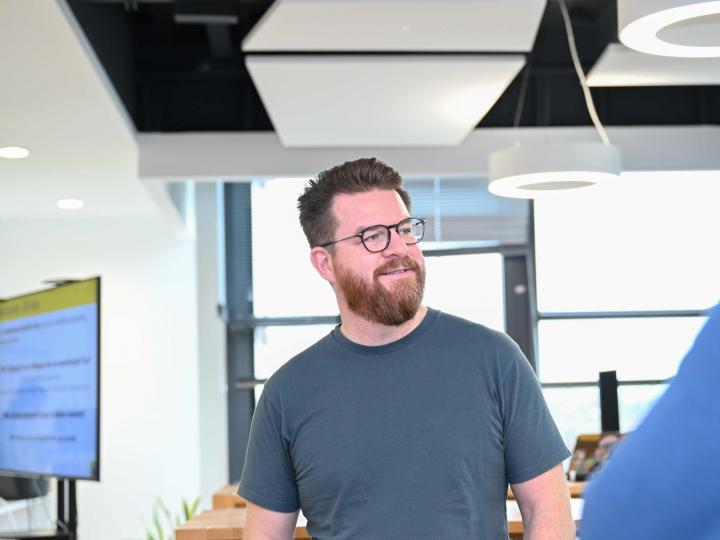
Declan Quinn's path into tech was anything but conventional. From Architectural Technologist to Engineering Manager at Liberty IT, his journey is proof that career pivots can lead somewhere great. We caught up with him to find out how he got here, and why he thinks now is the best time to make the leap into technology.
Can you talk us through your career journey and the moment you realised you wanted to move into technology?
I graduated university as an Architectural Technologist in 2004 – this path was a passion of mine until the financial crash of 2008 when I was made redundant.From that point I made a more conscious effort to plan my career and development. I got chartered, secured a public sector job and completed a part-time masters course in Project Management - all while holding down a full-time job, having two young children and starting my own house build where I acted as the client, designer and main contractor!

The masters course presented an opportunity to progress into technology. Another local tech company was seeking traditional project managers with no previous IT experience, so I made the jump to managing IT projects, which was daunting at first but soon became interesting. Six months after that there was an industry shift into agile methodology, which sent me on a whole new path of scrum and agile coaching – then in 2021 I joined Liberty IT as an Engineering Manager.
READ MORE: Liberty IT Teams Celebrate Success at Ignite 2025 Global Hackathon
What motivated your move to Engineering Manager and how would you describe the role to someone unfamiliar with it?
I have always had a passion for tech, being an early adopter of many aspects which helped me being neurodiverse with dyslexia. In the architecture industry, I needed to customise PCs to optimise performance for 3D visualisations, so this became a hobby, which led me into networking and learning about how the technology worked.
I led the introduction of CAD into thefirm I worked for at the time, planning the networking install, procuring the hardware and software needed to run a busy practice. Jumping into the IT sector has been very rewarding, no two days are the same as the sector has changed dramatically over the past 11 years.
What does a typical week look like for you as an Engineering Manager?
I manage three teams - around 15 people - so it’s busy! A typical week will include agile ceremonies at the team and platform level, running the tech leads calls, 1:1 check-ins with team members on goals and career growth, meeting with the employee group I’m a member of (more on this below!), checking in with my own mentor, and attending our weekly leadership meeting where we discuss resourcing, issues and any company-wide updates.
How is AI changing your role as an engineering manager, and how is it influencing the way your team designs, builds and delivers software?
AI is having an impact in terms of the wide array of tasks that it has the potential to help with - everything from researching complex problems in our space to creating agents which can manage the more mundane, day to day tasks.
So much is changing so quickly, I feel I’ve only scratched the surface - but being the first person on my team to create an agent and lead the way felt good. It’s also really important to be open and honest about the process, ensuring transparency when AI is used to add value.
Looking ahead, where do you expect AI to have the most meaningful impact on insurance technology over the next 12 months?
Getting involved in our Ignite global hackathon gave me an opportunity to see the ideas teams have at first hand – they’re using AI to monitor things like the condition of insurance customers’ roofs or overhanging trees, so they can reduce their premiums.
At the company level, AI helps us improve response times in natural disasters, while here at Liberty IT it frees engineers from repetitive and research heavy tasks, and helps us get new products out to market quicker.
You mentioned hackathons as an important part of how your teams innovate - how do they support learning, experimentation and collaboration, and why are they valuable for Engineering Managers?
I facilitate hackathons for my teams twice a year and I’ve created a playbook for this so anyone at Liberty IT can run their own event. Innovation time is vital for me and across our business – so we protect this time in our teams, knowing we can then demonstrate that innovation to senior leaders.
Thishas led to some great success stories, whether that’s specific techadvancementsor furtheringotherengineers' knowledge of the tools available and the breath of application available to them. Over the past two years,I’ve alsoled out on the Belfast location for Liberty Mutual’s global Ignite hackathon. I had a great team supporting me in the planning and during the three days, withemployees attendingfrom Belfast, Dublin and Galway. We’ve had great successes from the events too – last year our teams came away with three of the top prizes!
As a member of Liberty IT's ABLE employee group, who has spoken publicly about dyslexia, how do your own experiences inform the way you lead teams and advocate for inclusive, accessible ways of working?
I get to work with some amazing and diverse people - this is key to putting together a high performing team as we have different perspectives on complex issues and ways of working.It’s my job to harness these ideas, ensure everyone has a voice and that we arrive at the best solution for Liberty IT.
Being in the ABLE group helps me provide resources to both leaders and our engineers, to help them with their day-to-day tasks - this could be extra time, delivery or interacting with information, highlighting accessibility options, tool and resources.
READ MORE: Liberty IT Hosts Forward Live Celebrating Its Growth, Innovation & Connection
What advice would you give to someone considering a career change into technology, particularly those who may not see themselves reflected in traditional tech career paths?
I didn’tfollow a traditional technology career path and my previous experience has shaped my leadership style, allowing me to focus on empowering strong engineers and trusting their expertise.
My skill set as an Engineering Manager is to assemble high performing teams which deliver complex solutions, ensuring the best impact for our customers. Whether I am building ashopping centre or a new feature for our insurance offerings, the process remains the same: get the team together, break down the project into small deliverables that we can release incrementally, and learn on the way.
I would encourage anyone considering a career change into technology to do it,particularly now AI is proving to be the most impactful development of our time! It’s creating opportunities across a wide range of roles across the industry and it’s exciting to be part of it.
Sync NI's Spring 2026 magazine explores innovation and collaboration transforming Northern Ireland's technology ecosystem
This issue features exclusive insights from industry leaders on AI transformation, cybersecurity evolution, legal technology innovation, and how strategic partnerships between academia and business are accelerating real-world impact across the region.
Read the Spring 2026 edition free online →
Stay connected with NI's tech community: