Queen’s University Belfast has secured €3 million for an ambitious international research project that aims to develop a groundbreaking new method for concentrating laser light.
This new project, ExtremeField, will bring together researchers from Queen’s, Umeå University, Heinrich Heine University Düsseldorf, and the Helmholtz Institute Jena, combining their expertise to tackle this significant scientific challenge.
The €13.4 million European Research Council (ERC) Synergy Grant is part of the European Union’s Horizon Europe research and innovation programme.
READ MORE: AI Beyond the Hype: What Northern Ireland's Tech Leaders See Coming Next
The team will aim to produce light up to one million times more intense than is currently possible, with the intention of using it to investigate fundamental questions about light, matter, and empty space.
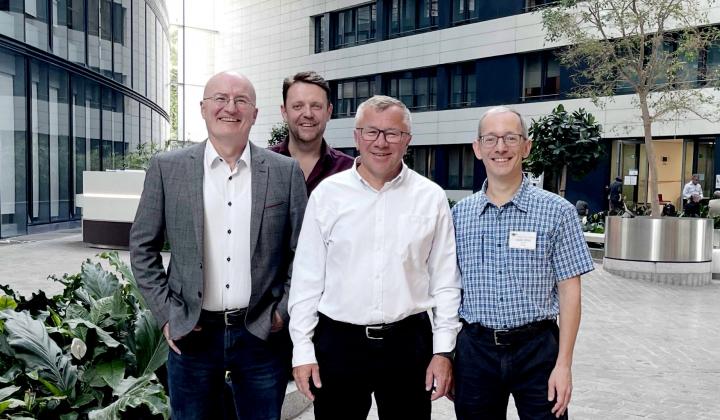
The Queen’s lead will be Professor Brendan Dromey from the School of Mathematics and Physics. Explaining the approach to the project, Professor Dromey said:
“The process begins with an ultra-intense laser pulse that turns a polished glass surface into plasma, creating a rapidly moving mirror that travels close to the speed of light. As the laser reflects from this surface, it generates much shorter wavelengths in the extreme-ultraviolet and soft X-ray regions. These combine to produce attosecond flashes and can be focused to an exceptionally small point using a microscopic plasma mirror.”
This approach, known as coherent harmonic focusing, concentrates the laser pulse in both space and time. Calculations suggest that it could increase the intensity at the focus by up to one million times.
“With ExtremeField, we aim to create, for the first time, experimental conditions near the Schwinger limit where quantum effects in a vacuum can be measured,” explains project coordinator Professor Matt Zepf of the Helmholtz Institute Jena, a research outstation and branch of the GSI Helmholtz Centre for Heavy Ion Research.
He adds: “We plan to conduct experiments at our high-power laser JeTi in Jena, Taranis in Belfast, Light Wave Synthesizer 100 (LWS100) in Umeå and develop a new class of lasers to achieve maximum possible performance with the team-members in Umeå.”
A central challenge will be controlling the instant at which the glass surface becomes plasma and shaping it so that the reflected light forms a Coherent Harmonic Focus.
Professor Brendan Dromey continued:
“ExtremeField brings together ultrafast materials science, advanced laser technology, and innovative plasma physics. By combining expertise across the four partner institutions, we will be able to tackle a challenge that no single team could solve alone. At Queen’s, we will help establish the precise conditions needed to create and control this new source of extreme light.”
At Heinrich Heine University Düsseldorf, Professor Alexander Pukhov’s team will develop computer models of the laser-plasma interaction and run them on high-performance computers in Düsseldorf and Jülich.
And, at Umeå University in Sweden, Professor László Veisz is establishing the new SUPER laser. It will produce pulses as short as half a cycle of light while reaching petawatt peak power, pushing current laser technology to its limits.
For more information on the project, visit www.erc.europa.eu/homepage

Read the Autumn 2026 edition free online →
Stay connected with NI's tech community: