
Artificial intelligence has moved beyond experimentation. From healthcare and financial services to public sector transformation and advanced manufacturing, artificial intelligence is already reshaping how organisations operate.
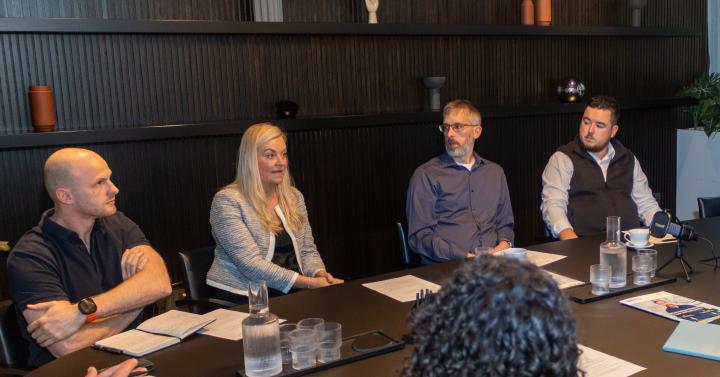
At the second of three AI roundtablesSync NI brought together technology leaders and industry experts from across Northern Ireland explored where AI is delivering real value today, the barriers to wider adoption, and the ethical and societal questions that will define its future.
Gathered together once again in the boardroom of URBAN HQ’s impressive city centre offices the assembled panel of senior leaders and experts included Adam Hale Lead full stack engineer Allstate; John Maguire AI Policy Lead AICC; Scott Fischaber CEO Analytics Engines; Beverley Noye Site Lead TP ICAP; Emma Proctor Head of Operational and Technology Risk Danske; Dave Vincent Executive Lead NI Public Sector AWS; Jessica O’Brien AI & Data, Health & Public Services Accenture and Niall Haslem Senior Engineering Manager Apex Fintech Solutions

For many organisations, AI is no longer a future capability discussed only in innovation workshops and technology conferences. It is becoming embedded in customer service platforms, software development processes, compliance operations, public services, healthcare systems and strategic decision-making. Across sectors, organisations are progressing from asking what AI might do to understanding what it is already doing.
The discussion offered a valuable snapshot of how Northern Ireland's technology community is navigating a rapidly evolving landscape that presents enormous opportunities alongside significant challenges.
While AI is already delivering measurable value, data quality remains a critical obstacle. Governance and trust are becoming more important than the technology itself while skills development is emerging as a strategic priority. As the discussion will illustrate, the debate is increasingly moving away from technology and towards people.
The consensus was clear: the future of AI will be determined not simply by what the technology can do, but by how responsibly organisations choose to use it.One of the clearest messages from the discussion was that AI's value is no longer theoretical.
Participants shared examples where AI is already producing tangible outcomes for businesses, public services and citizens. While much public attention continues to focus on generative AI chatbots, the examples highlighted at the roundtable demonstrated the breadth of real-world deployment across very practical challenges.
Public sector use cases featured prominently. One example involved the processing of millions of handwritten communications submitted annually by citizens. By combining optical character recognition technology with large language models, the system can read, categorise and prioritise correspondence before routing it for human review.
The result is not simply greater efficiency. In some situations, citizens who may previously have waited weeks for a response can now receive assistance within days or even hours. A clear demonstration of how AI can create value not only through cost reduction but through better public outcomes and improved service delivery.
Healthcare was another area where participants pointed to substantial benefits.Applications ranging from diagnostics and medical imaging analysis to patient triage and predictive healthcare modelling are already demonstrating considerable promise. Although attendees acknowledged that healthcare adoption will inevitably be more cautious because of patient safety considerations, many felt that it has the potential to become one of the sectors most profoundly transformed by AI over the next decade.
The ability to identify diseases earlier, improve clinical decision-making and streamline access to healthcare services was repeatedly mentioned as an area where AI could deliver meaningful societal impact.
AI’s impact on financial services also featured heavily throughout the discussion.AI is already prevalent across customer onboarding, compliance, anti-money laundering activities and internal operations.Historically, onboarding a new client in a highly regulated environment could take months. The combination of compliance requirements, technical integration and risk assessments often created lengthy implementation timelines.
Today, AI-assisted development tools, intelligent documentation systems and automated compliance workflows are helping organisations significantly reduce these onboarding cycles. In some cases, processes that once took six to twelve months can now be completed in a matter of weeks.
The benefits extend beyond operational speed.Participants reported improved client experiences, faster access to information and greater consistency across customer interactions. AI-powered knowledge systems are allowing employees to access expertise more quickly and provide more accurate responses to customer enquiries.
A recurring theme was that AI is enabling staff to focus on higher-value activities rather than replacing them altogether.One example discussed involved automated collection of publicly available information to support ‘know-your-customer’ and client onboarding processes. Rather than reducing staffing levels, automation allowed teams to spend more time focusing on higher-risk cases that require specialist human judgement.
While headline-grabbing examples often dominate public discourse, many participants argued that the biggest impact of AI may ultimately come from thousands of smaller productivity improvements occurring throughout organisations every day.Employees increasingly use AI tools to summarise information, generate meeting notes, draft communications, analyse documents and surface relevant policies or procedures.
Banks, insurers and large enterprises described using AI to provide staff with immediate access to internal policies, procedural guidance and operational knowledge. This creates greater consistency, reduces training requirements and allows employees to respond more effectively to customer needs.
In customer-facing environments, AI tools are helping standardise communications across phone, email and digital channels resulting in a more consistent customer experience, regardless of which employee handles an enquiry.
Software development teams have experienced particularly dramatic changes. AI-assisted coding tools are helping developers generate code, create documentation, write tests and accelerate development workflows. While human oversight remains essential, many organisations now regard these tools as a core part of the development process. Many developers who were initially sceptical of AI have become some of its strongest advocates after experiencing the productivity gains firsthand.
Yet amid the enthusiasm, participants repeatedly stressed that AI is not a magic solution.In many cases, organisations are discovering that successful AI adoption depends on addressing longstanding operational issues that predate AI altogether.
Data quality emerged as perhaps the most frequently cited challenge.Many businesses are eager to deploy AI solutions but have not invested sufficiently in the quality, structure and governance of their data. As a result, AI systems often expose weaknesses that have existed unnoticed for years.Poor data inevitably produces poor outcomes, regardless of how sophisticated the AI model may be.
Several attendees argued that AI is forcing organisations back to fundamentals. Better documentation, stronger testing practices, clearer requirements and improved governance all become increasingly important when automation accelerates decision-making and operational processes.
In software engineering, for example, AI amplifies both strengths and weaknesses. Organisations with mature development practices often see substantial gains. Those with poor documentation, limited testing or weak governance frequently find that AI magnifies existing problems.
As one participant observed, many of the disciplines organisations now find themselves adopting are simply practices they should have been following all along.
In terms of organisational readiness the room largely agreed that technology is rarely the primary obstacle to AI adoption given that the tools and platforms already exist as capabilities are advancing rapidly.
Many businesses continue to adopt a technology-first mindset, asking what AI can do before defining the problem they are trying to solve.This flawed approach frequently leads to disappointing outcomes.
Successful AI programmes typically begin with a specific business problem rather than a specific technology.What process needs improvement? What customer challenge needs addressing? What outcome is the organisation trying to achieve?Only then should AI be considered as a potential solution.
Organisations that approach AI solely as a technology implementation project risk overlooking the broader transformation required to realise meaningful value.Several attendees referenced emerging research suggesting that organisations achieving the greatest benefits from AI are focusing less on technological deployment and more on organisational adaptation.In many respects, AI adoption is becoming a leadership challenge rather than a software challenge.
The discussion around regulation revealed a notable level of agreement.While public debates often frame regulation and innovation as competing priorities, participants generally rejected this binary view.Instead, many argued that effective regulation creates the trust necessary for innovation to flourish.
Without confidence in how AI is developed, governed and deployed, organisations will struggle to achieve widespread adoption among employees, customers and citizens.Trust therefore emerged as the critical intermediary between regulation and innovation.
The rapid pace of AI development means regulators are frequentlyattempting to govern technologies that continue to evolve faster than policy frameworks. This creates uncertainty for organisations trying to navigate multiple regulatory regimes.
Differences between European and UK approaches were cited as examples of this challenge. Businesses operating internationally must increasingly understand and comply with varying legal requirements, standards and expectations.
Yet many attendees argued that strong governance should ultimately be viewed as a competitive advantage rather than a burden.Organisations that can demonstrate transparency, accountability and responsible AI practices may enjoy stronger customer trust and greater long-term resilience.
For heavily regulated sectors such as banking, insurance and healthcare, robust governance is already becoming a prerequisite for deployment.
The term "responsible AI" is often used in industry discussions, but participants spent considerable time exploring what it means in practice.
The conversation moved beyond abstract principles and focused on operational realities.For many organisations, responsible AI begins with governance frameworks that clearly define accountability, risk management processes, oversight structures and decision-making responsibilities.
Before deploying AI systems, organisations increasingly need policies covering appropriate use, acceptable risk thresholds, human oversight requirements and escalation procedures.Several attendees described how initial excitement around AI experimentation ultimately gave way to recognition that governance needed to come first.
Proofs of concept may be relatively easy to launch. Scaling AI safely across an organisation is considerably harder.Participants discussed the importance of creating clear ownership structures so that responsibility never becomes disconnected from decision-making authority.Ultimately, responsible AI is not simply about technology. It is about ensuring organisations retain control over how technology is used.
Perhaps the most significant ethical challenge identified during the roundtable was accountability.As AI systems become more autonomous, the question becomes increasingly difficult: who is responsible when something goes wrong?
If an AI system contributes to a financial decision, an insurance assessment, a healthcare recommendation or a software deployment failure, where does accountability reside?Participants were unanimous that responsibility cannot be transferred to an algorithm and human accountability must remain central.
Yet from an operations standpoint this principle becomes increasingly difficult as organisations introduce agentic systems capable of undertaking complex tasks with limited human intervention.The challenge is compounded by explainability.
Businesses operating in regulated environments must often demonstrate why decisions were made. Black-box systems that cannot provide transparent reasoning may create significant governance and compliance risks.
This is particularly relevant in sectors such as healthcare, financial services and public administration, where decisions can have life-changing consequences.For participants, transparency, explainability and accountability are rapidly becoming defining characteristics of trustworthy AI systems.
Discussion inevitably turned to employment. Despite concerns often expressed in wider public debate, participants generally rejected simplistic narratives about AI replacing entire workforces.Most expected AI to reshape jobs rather than eliminate them outright.
However, significant concern was expressed about entry-level roles.Many professionals build expertise through junior positions that involve administrative support, testing, documentation, analysis and routine operational activities. These are precisely the kinds of tasks most susceptible to automation.The concern is not necessarily immediate unemployment.Rather, it is the potential erosion of traditional development pathways that allow individuals to gain experience, learn industry knowledge and progress into senior positions.
How does someone become an expert when many of the tasks through which expertise is traditionally acquired are increasingly automated?
Participants described this as one of the most important workforce questions facing organisations over the coming years.

Education was also identified as a critical factor.Students will need to understand not only how to use AI tools but how to challenge, evaluate and critically assess AI-generated outputs. Technical proficiency alone will not be sufficient.Judgement, critical thinking and domain expertise may become even more valuable in an AI-enabled economy.
While current discussions often focus on productivity and business value, attendees warned that future ethical debates may centre on trust and authenticity.Deepfakes, synthetic media and AI-generated misinformation were identified as growing concerns.
Participants argued that society has only begun to experience the implications of increasingly sophisticated synthetic content.The technology is advancing faster than many governance structures, educational systems and public awareness initiatives can adapt.Questions around authenticity, identity verification and information trustworthiness are therefore likely to become more prominent over the coming years.
Participants also stressed the importance of protecting vulnerable groups from harmful uses of AI and ensuring legal frameworks keep pace with emerging risks.The challenge extends far beyond technology and increasingly intersects with social, political and cultural questions.
As the discussion drew to a close, attention focused on Northern Ireland's place within the global AI landscape.Most attendees were realistic about the region's position. Few believed Northern Ireland would compete directly with the United States or China in developing frontier AI models.However, there was considerable optimism about its ability to lead in AI adoption, implementation and application.
Participants argued that the region's greatest opportunity lies in helping indigenous businesses use AI to become more productive, innovative and globally competitive.Small and medium-sized enterprises were viewed as particularly important.
Given the significant role SMEs and family-owned businesses play in the local economy, helping those organisations adopt AI effectively could generate considerable economic impact.
There was also discussion around entrepreneurship. Several attendees suggested AI is lowering barriers to creating highly scalable technology businesses, creating opportunities for a new generation of founders.The challenge now is ensuring Northern Ireland develops the skills, support structures and investment ecosystem needed to capitalise on that opportunity.
The opportunities presented by AI are substantial and increasingly visible. Yet technology alone will not determine success. Trust, governance, education, accountability and leadership will prove equally important.
If Northern Ireland can successfully combine its technical expertise with responsible adoption and a focus on real-world outcomes, it has an opportunity not necessarily to lead the development of AI, but to become a leader in how AI is applied, and that may be where the greatest value lies.


Read the Autumn 2026 edition free online →
Stay connected with NI's tech community: