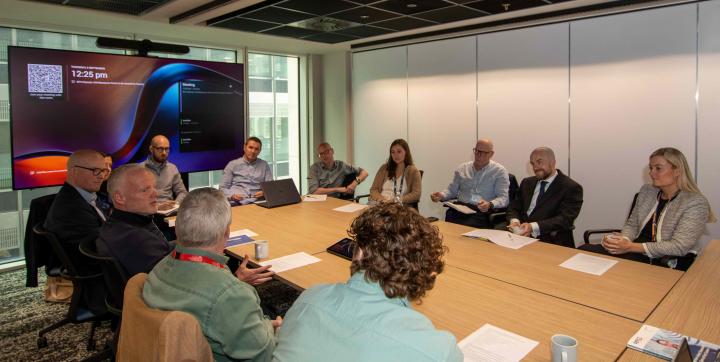
From agentic AI and robotics to quantum computing and workforce transformation, Sync NI’s third and final AI roundtable in the series explores how artificial intelligence is reshaping business, society and the future of work.
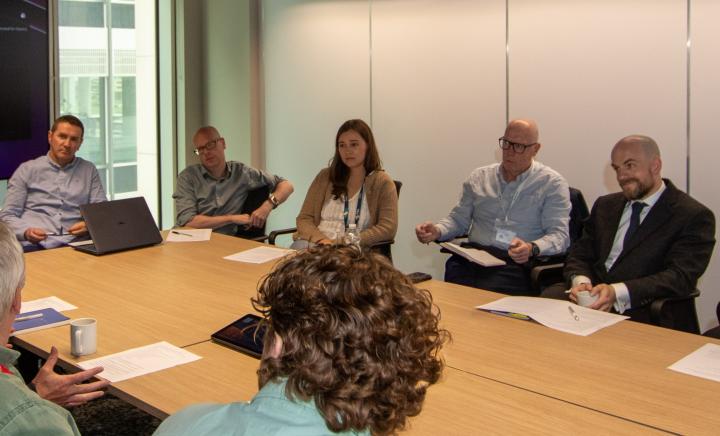
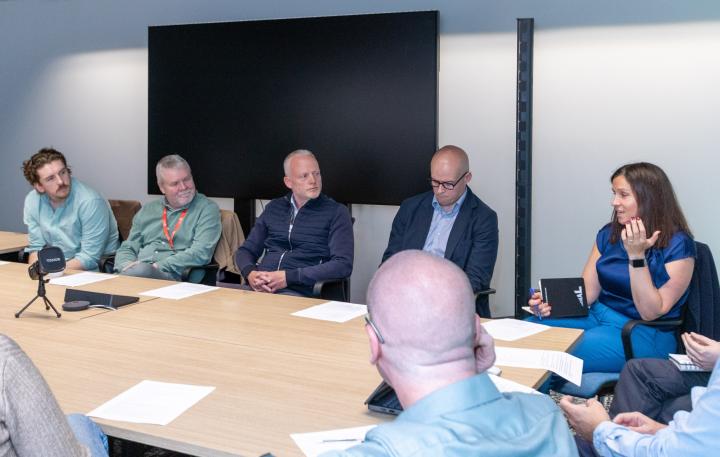
Hosted in TP ICAP’s new Belfast offices in City Quays 3 Sync NI was joined by an esteemed panel oftechnology leaders and industry experts from across Northern Ireland’s digital economyincluding Beverley Noye Site Lead TP ICAP; Donnacha Kirk Deputy Director of AI Technology and Research Services AICC; Jessica Barr Data Scientist Aflac; Andy McClernon Director of Engineering QUB Momentum One Zero; Pete Wilson Digital Director and Programme Lead CGI ; Simon Curran. Director of Architecture Liberty IT; Dean Corry Director Data Science Allstate; Anne Taylor NI Digital Core Lead Accenture; Neil Hutchison CEO Software NI and Marc Nevin, Solution Architect Kainos
While views differed on the pace of change, there was broad agreement on one point: AI is no longer a standalone technology trend. It is rapidly becoming a foundational layer of modern business and society.


Three years after generative AI burst into the mainstream, the conversation is shifting beyond ChatGPT and large language models. Organisations are increasingly focused on practical adoption, return on investment, governance, workforce implications and the opportunities emerging from the next generation of AI capabilities.
What emerged from the discussion was a picture of a technology moving from experimentation to implementation. The era of curiosity is ending and the era of operationalisation has already begun.
Many organisations have spent the last two years trialling AI tools, exploring potential use cases and testing productivity gains. That process has generated valuable lessons about both the promise and limitations of current technologies.
Participants agreed that AI is becoming ubiquitous and will become ever more increasingly embedded within business systems and everyday experiences. Rather than interacting with dedicated AI applications, users will engage with smarter software, more personalised services and increasingly intelligent devices.
In much the same way that cloud computing became an invisible part of modern technology infrastructure, AI is expected to fade into the background. Within five to ten years, organisations may no longer market products as “AI-powered” because intelligent functionality will simply be assumed.
However, widespread adoption has also highlighted significant challenges, touched upon in the previous roundtables. Data quality, governance, reliability and cost remain major barriers to successful implementation.
Many companies have now discovered that AI effectiveness depends heavily on the quality of underlying data. Fragmented information, inconsistent data models and legacy systems often create greater obstacles than the AI technology itself.
For organisations operating in regulated industries, moving from proof-of-concept projects to enterprise-wide deployment presents an additional layer of complexity. Scaling AI requires robust governance, security controls, testing frameworks and operational discipline.
Participants also noted that while AI has accelerated software development, it has simultaneously created a growing volume of poorly engineered applications. Lessons have been learned, and faster development does not automatically translate into better software.
As a result, traditional engineering disciplines including architecture, documentation, testing and maintainability remain critical. Several contributors suggested these fundamentals may become even more important in an AI-driven world.
One participant described the current environment as a period of “bloat”, with organisations often layering AI onto existing processes rather than redesigning how work is performed. Over time, businesses are expected to become more selective, identifying where AI delivers genuine value while removing unnecessary complexity.
The Economics of AI is a reality that cannot be ignored and questions around cost and sustainability featured prominently throughout the discussion.
While many AI services appear affordable at first glance, participants questioned whether existing pricing models can endure. Every AI interaction depends on substantial computing infrastructure, significant energy consumption and continuous investment in model training and development.
Technology leaders increasingly face pressure to demonstrate measurable returns on investment. Productivity gains are often visible, but translating those gains into clear financial outcomes remains challenging.
At the same time, the emergence of smaller, more efficient models and open-source alternatives may help reshape the economics of AI. Several participants suggested that as sophisticated capabilities become available through lower-cost solutions, some concerns around affordability could diminish.
The consensus was that the AI market remains in a period of rapid evolution. Competitive dynamics, pricing structures and business models are likely to look very different within the next five years.
If generative AI represented the first phase of the current wave of innovation, many participants believe agentic AI will define the next.
Unlike today’s systems, which primarily generate content or answer questions, agentic AI can be assigned objectives and autonomously carry out tasks to achieve them.
Participants described a future in which personal and enterprise agents maintain context, understand user preferences and coordinate activities across multiple systems.Applications could include managing travel arrangements, conducting research, overseeing procurement activities, automating compliance processes and handling routine administrative work.
Several contributors envisaged highly personalised digital assistants capable of arranging meetings, making purchases and completing everyday tasks without constant human involvement.The implications extend beyond productivity. As AI agents increasingly act on behalf of consumers, businesses may find themselves competing for the attention of algorithms rather than people. This could reshape customer engagement, marketing and decision-making.
However once again, as per our previous roundtables, trust and governance emerged as major concerns.Once AI systems begin initiating actions rather than simply making recommendations, organisations will need clear frameworks governing what those systems can do and when human oversight is required.
Participants argued that traditional AI guardrails may not be sufficient. Future governance models may need to resemble cybersecurity architectures, incorporating permissions, monitoring, auditing and layered approval mechanisms.
The challenge is not solely technical. Businesses may need to redesign operating models and workflows rather than simply adding AI tools to existing processes. Those willing to fundamentally rethink how work is organised are likely to see the greatest benefits.
One of the most thought-provoking sections of the discussion focused on AI’s impact on human cognition.Some participants expressed concern that growing reliance on AI could weaken critical thinking, problem-solving abilities and independent judgement. As systems become more capable, there is a risk that people may increasingly defer to machine-generated answers instead of engaging deeply with difficult questions.
Historical parallels were frequently referenced. Calculators changed mathematics education; GPS reduced reliance on navigation skills and search engines transformed information gathering. AI may represent a similar shift, albeit on a much larger scale.The concern extends beyond education into professional environments. As AI takes on more cognitive tasks, some traditional skills may begin to deteriorate through lack of use.
Others offered a more optimistic perspective, arguing that technological advances have consistently reshaped rather than diminished human capability. While certain skills become less important, new opportunities emerge for creativity, innovation and higher-order thinking.Several participants observed that younger users often display a healthy scepticism towards AI outputs, recognising inaccuracies and hallucinations that others may overlook.
Ultimately, the discussion arrived at a balanced view. AI will undoubtedly change how people think and work, but human judgement, contextual understanding and critical analysis will remain highly valuable.
While public attention often focuses on chatbots and content generation, participants highlighted significant opportunities in physical AI and robotics.
Manufacturing emerged as a particularly promising area. Advances in digital twins, industrial simulations, computer vision and AI-powered optimisation are enabling manufacturers to model operations virtually, identify inefficiencies and test improvements before implementing changes in the real world.
Large manufacturers are already achieving measurable gains through these technologies. However, participants emphasised that transformational outcomes do not necessarily require substantial investment.
Smaller manufacturers can often achieve meaningful improvements using relatively simple technologies such as low-cost sensors, machine vision systems and AI-powered monitoring tools.
Businesses that previously relied on limited operational data can now capture real-time insights into processes, helping reduce waste, increase efficiency and improve decision-making.
Agriculture was also highlighted as an area of significant opportunity. Northern Ireland’s strong agricultural heritage, combined with advances in sensing technologies, predictive analytics and automation, creates opportunities to improve productivity while supporting sustainability goals.
Many participants believe robotics may ultimately become one of the most transformative applications of AI. As systems improve at understanding and interacting with physical environments, robots are expected to move beyond structured industrial settings into logistics, healthcare, warehousing and field operations.Although adoption timelines remain uncertain, there was broad agreement that advances in physical AI may be as consequential as those occurring in software.
The conversation also explored quantum computing and how this would factor into the future, a technology that continues to generate significant interest despite remaining in its early stages.
Participants described quantum computing as a fundamentally different approach to processing information, capable of solving certain classes of problems much faster than traditional computers.Unlike classical computing systems, which rely on binary bits, quantum computers utilise properties such as superposition and entanglement to perform calculations in entirely new ways.
Despite exciting progress, participants stressed that quantum computing remains an emerging technology. Challenges around scale, stability and reliability continue to limit practical deployment.As a result, most participants viewed quantum as a medium- to long-term opportunity rather than an immediate disruption.
Cybersecurity emerged as the most pressing near-term consideration. Organisations are increasingly exploring post-quantum cryptography to defend against future threats posed by powerful quantum systems.
Particular attention was given to the concept of “harvest now, decrypt later”, whereby sensitive information stolen today could potentially be decrypted in the future as quantum capabilities advance.This means organisations may need to begin preparing long before large-scale quantum computers become commercially viable.
Beyond cybersecurity, attendees highlighted potential applications in financial modelling, portfolio optimisation, pharmaceutical research, materials science, weather forecasting and scientific simulation.
Several participants suggested that some of the earliest commercial opportunities may arise not from building quantum computers, but from helping organisations prepare for their eventual arrival.
With this in mind, the panel was asked to what extend we need to be rethinking skills and education to prepare the future workforce.Workforce development emerged as one of the most important themes of the discussion.
Participants acknowledged the challenge facing universities and education providers. Technological change is unfolding faster than traditional curriculum cycles can adapt, while employers increasingly expect graduates to arrive with practical AI knowledge and multidisciplinary skills.
Despite rapid technological advances, there was strong agreement that foundational competencies remain essential. Software engineering, systems thinking, problem-solving, architecture and analytical reasoning continue to provide the basis for successful careers.
The discussion suggested that future workers may require broader skill sets rather than narrower specialisation.Increasingly, the most effective teams combine expertise across engineering, operations, governance, product development, data science and customer engagement. Organisational boundaries between disciplines are becoming less rigid.
The concept of multidisciplinary “fusion teams” resonated strongly with participants. In these environments, technical and non-technical professionals work more closely together, sharing knowledge and contributing beyond conventional role definitions.
Attention also turned to practical experience and talent development.Several participants expressed concern about declining internship and placement opportunities. While AI may reshape entry-level work, organisations still require effective pathways for developing future talent.Without continued investment in junior professionals, businesses risk creating shortages of experienced technical leaders in the years ahead.
Alongside traditional university education, growing importance is being placed on apprenticeships, boot camps, micro-credentials and lifelong learning initiatives.Increasingly, the objective is not to teach a fixed set of skills but to foster adaptability and continuous learning.
The discussion concluded by examining Northern Ireland’s position within the global AI landscape.
Once again, few participants believed the region could realistically compete with technology superpowers in building foundation models, advanced semiconductors or hyperscale infrastructure. The scale of investment required is simply too great.
However, participants strongly rejected the notion that leadership depends on creating foundational technologies.Instead, Northern Ireland’s opportunity lies in application, adoption and specialisation.
One area of potential strength is trust, governance and assurance. The region’s established expertise in cybersecurity, software engineering and regulation positions it well to help organisations deploy AI safely and responsibly.
Another opportunity lies in accelerating AI adoption across existing sectors including financial services, manufacturing, agriculture and the public sector.
Entrepreneurship also featured prominently in the discussion. As AI lowers barriers to product development and company formation, Northern Ireland may be able to create globally competitive businesses with smaller teams and lower costs than previously possible.
Participants also highlighted existing strengths in cybersecurity, software development, manufacturing, agri-tech and financial services as foundations upon which future growth can be built.Rather than attempting to become another Silicon Valley, Northern Ireland can differentiate itself by applying emerging technologies to solve real-world problems.
Education remains central to that ambition. Participants repeatedly returned to the importance of AI literacy, digital skills development, stronger collaboration between industry and academia, and creating pathways that allow people from all backgrounds to participate in the opportunities created by AI.
A clear conclusion emerged from the discussion: AI should no longer be viewed as a standalone technology trend.The future will be shaped not by AI itself, but by the products, services, industries and innovations built on top of it.
For Northern Ireland, success is unlikely to depend on building the world’s largest models or competing directly with global technology giants. Instead, the region’s opportunity lies in combining its established strengths in technology, cybersecurity, manufacturing, engineering and entrepreneurship with the possibilities created by AI.
The question is no longer whether AI will transform society. Most participants were convinced that it will.The more important challenge is whether organisations, educators, policymakers and business leaders can adapt quickly enough to capture the benefits while managing the risks.
As the roundtable concluded, one message stood out above all others: the winners of the AI era may not be the organisations that create the technology, but those that learn fastest how to apply it. For Northern Ireland, that could prove both the defining challenge and the defining opportunity of the decade ahead. Let’s be optimistic, with a strong tradition and history for innovation and invention Northern Ireland has every chance of building world class products and services underpinned by Artificial Intelligence.

Read the Autumn 2026 edition free online →
Stay connected with NI's tech community: