Northern Ireland’s software sector is one of theregion’s most significant economic successstories. Employing more than 23,000 people across a range of domains, the industry plays a pivotal role in driving investment and value add to employment and our wider economy.
Whilst software now underpins every major sector of the economy, the ability to actually create and deploy technology solutions – including AI - in any setting remains crucial and a growth opportunity.
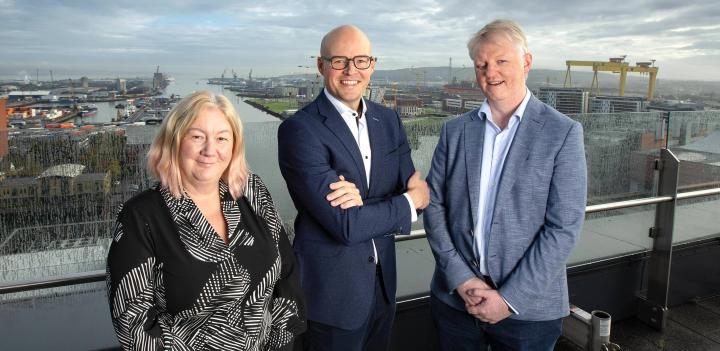
For Chair of Software NI Lorna McAdoo, CEO Neil Hutcheson and the wider membership, to secure and sustain this success into the future - close collaboration between industry, government and education institutions is essential.
READ MORE: AI Beyond the Hype: What Northern Ireland's Tech Leaders See Coming Next
Established in 2022 Software NI was first created by six companies – large and small - to provide a collective voice for the software industry. Today the organisation is focused on ensuring NI sustains and accelerates a reputation for software businesses across key verticals. This takes a proactive approach to ensuring change, rather than stating the need for it.
The strategy centres on four key pillars: schools, skills,sales and scaling – whilst helping the maximum number of software companies ride waves of change including AI, regulation and beyond. Together, these represent the systems that determine whether NI can remain competitive in an ever-changing global market.
Neil explains “As the saying goes, what gets you there doesn’t necessarily keep or take you there. We are lucky there are industry leaders who recognise the challenges and opportunities can be grasped by working together – first between industry companies, large and small. Then with government as colleagues. It’s a powerful proposition.”
Software NI has established volunteer-led working groups, each focused first on identifying system constraints or opportunities for acceleration.
One of the industry's greatest aims is incentivising young people develop an interest in technology in the widest sense. The Software NI Schools Working Group focuses on maximising the number of children excited by and choosing technology subjects, through exposure to software-related skills and opportunities from an early age. Software NI has now invested several years engaging with educators and policymakers to help shape the new curriculum development and strengthen digital learning within schools.
The Department of Education has accepted key Software NI recommendations into the official curriculum review. Pending legislation, space will be allocated in the timetable for all children to access software sector related skills from primary school up - not as an option, but as a core part of the curriculum.
In addition to this, a £6 million STEM teacher bursary fund was secured in 2025 to cover training costs and annual stipend for new teachers. A talented person wanting to start or even switch into teaching ICT no longer has to absorb the tuition cost. Creating an incentive.
A third leg of the stool is perhaps the most ambitious. Software NI is pursuing a goal of connecting every post-primary school in Northern Ireland with a software company by 2028. By fully integrating an industry company and school in a coordinated way, it gives teachers certainty and leads to a clearer understanding of technology for children as it moves rapidly. Why? Because the perfect curriculum does not exist.
Initiatives such as the Northwest and mid ulster Digital Hubs, led by founding member Allstate, demonstrate how companies can play a practical role in seeding pilots for digital skills across all regions of Northern Ireland. Without industry coordination and leadership, this kind of prototype may be impossible for government to pilot and get evidence of success.
While encouraging more young people into technology is essential, Software NI recognises that there remains opportunities for career changers, apprentices and underrepresented groups. Its Skills Working Group focuses on creating more accessible routes into software careers while ensuring higher and further education providers remain aligned with industry demand.
One of its flagship initiatives ‘SoftwareForAll’ is delivered with Workplus and designed to increase software apprenticeship demand by employers with a focus on increasing participation by women. In its pilot phase, the initiative created close to a £1million of additional apprenticeship salaries – with a 50% of employers taking on software apprentices for the first time.
Lorna explains “Getting people into the software industry is one thing, however ensuring they develop the skills companies actually need is just as important. We also look for traits and know many young talented people can be hired straight out of school or via alternative routes”
On account of new and re-emerging software skill requirements, in October 2026 Software NI will also launch recruitment for a AI bootcamp for 50 students, again in partnership with Workplus and a team of elite engineers. The pilot bootcamp is designed to supplement university teaching, with AI, soft skill and project components designed to maximise the chances of connecting each person with a role in industry.
Alongside the seeding of more formal education initiatives, the organisation has established an Early Career Board - for 12 people at the start of their career - matched to members of its primary board. The early career board runs the bustling Early Tech Talent meet up group across Software NI member company sites.
These efforts aim to hone the next generation of leaders as early as possible, recognising that experience is key but young people with the right ‘traits’ and drive to succeed are to be trusted and helped to progress as soon as possible.
I is widely recognised for its software engineering expertise but technical excellence alone is not enough to drive growth. Its Sales and Scale Working Group focuses on helping technology businesses increase sales capability at home and abroad, having identified the need to match our regions technical expertise.
This first led to company introductions and the launch of SalesandScale.com, the conference dedicated to highlighting the importance of sales within the technology sector and learning from others.
Working alongside organisations such as Invest NI and the Department for the Economy, Software NI has advocated for programmes that make specialist sales training and leadership development more accessible. This led to things like the first ever Software Sales Academy for 20 people in August 2026 - many participants secured jobs in companies such as First Derivative-EPAM, Cloudsmith, Cranmore and more.
While these kinds of interventions may appear incremental, they are on part of the jigsaw and begin to address a longstanding gap in the local ecosystem - providing additional support for homegrown companies seeking to compete globally.
READ MORE: People, Purpose and Performance: Redefining Culture in Northern Ireland's Technology Sector
Lorna summarises the issue “When systems align, things change fast. A teacher with proper support teaches differently. A young person with mentors and real job offers chooses differently. A company with effective sales training and connections scales faster. When policy and industry incentives point the same direction, success follows”
Neil continues “It’s essential to understand how constraints and incentives impact systems, before you can really make a difference. Once you know where the blockage sits, whatever is in the way becomes the way. After that, relentless ambition and relationships are the key.”
The impact of these initiatives and wider activity of Software NI will extend beyond the technology industry itself. And from what we hear, this is just the beginning of something much bigger.

Read the Autumn 2026 edition free online →
Stay connected with NI's tech community: