Babies as young as two months old can categorise objects in their brains - much earlier than previously thought - according to new research by scientists at Queen’s University Belfast, Trinity College Dublin and Stanford University.
The researchers, who were assisted by the Coombe and Rotunda Hospitals in Dublin, used brain imaging and artificial intelligence models in their study of 130 two-month-old infants.
Lying on a comfy beanbag and wearing sound-cancelling headphones, the babies were shown bright, colourful images for 15-20 minutes. The scientists then used functional MRI (fMRI) to measure how their brains responded to pictures of 12 common visual categories such as a cat, bird, rubber duck, shopping cart and tree.
READ MORE: New seagrass meadow discovered in Northern Ireland by PhD student using DAERA technology
Artificial intelligence models were then used to characterise how the babies’ brains represented the different visual categories.
The study has been just published in the journal Nature Neuroscience. It was led by a team from Trinity College Institute of Neuroscience (TCIN) and the School of Psychology. Two of the researchers are now based at Queen’s University Belfast and Stanford University.
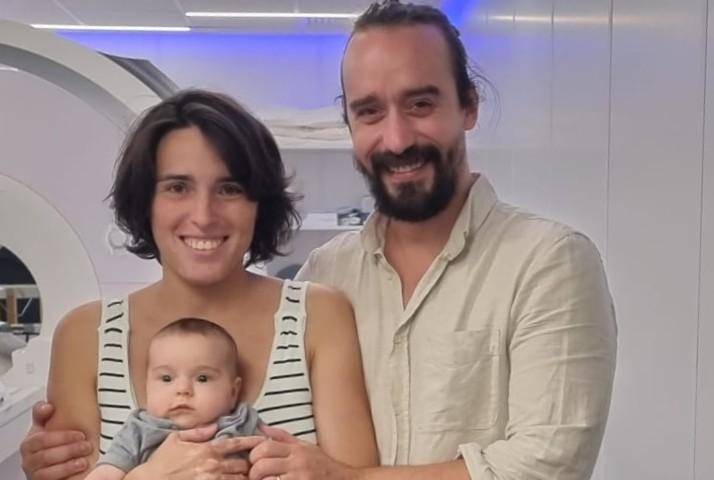
Dr Anna Truzzi, from Queen’s University Belfast, is a co-author on the paper. Her daughter Maeve took part in the study when she was just two months old.
Dr Truzzi comments: “My daughter Maeve took part in the study when she was just two months old. As a mother and a researcher, it is fascinating to find out more about what a very young baby can see and make sense of!
"Until recently, we could not reliably measure how specific areas of the infant brain interpreted visual information. By combining AI and neuroimaging, our study offers a very unique insight, which helps us to understand much more about how babies learn in their first year of life.
“The first year is a period of rapid and intricate brain development. This study provides new foundational knowledge which will help guide early-years education, inform clinical support for neurodevelopmental conditions and inspire more biologically-grounded approaches in artificial intelligence.”
Dr Cliona O’Doherty, lead author on the study who conducted the research while in Trinity’s Cusack Lab, explains: “Parents and scientists have long wondered what goes on in a baby’s mind and what they actually see when they view the world around them. This research highlights the richness of brain function in the first year of life.
“Although at two months, infants’ communication is limited by a lack of language and fine motor control, their minds were already not only representing how things look, but figuring out to which category they belonged. This shows that the foundations of visual cognition are already in place from very early on and much earlier than expected.”
Team lead Rhodri Cusack from the Thomas Mitchell Professor of Cognitive Neuroscience at Trinity’s School of Psychology and Trinity College Institute of Neuroscience, comments: “This study represents the largest longitudinal study with functional magnetic resonance imaging (fMRI) of awake infants. The rich dataset capturing brain activity opens up a whole new way to measure what babies are thinking at a very early age. It also highlights the potential for neuroimaging and computational models to be used as a diagnostic tool in very young infants.
“Babies learn much more quickly than today’s AI models and by studying how they do this, we hope to inspire a new generation of AI models that learn more efficiently, so reducing their economic and environmental costs.”
Professor Eleanor Molloy, a neonatologist from Children’s Health Ireland and co-author, emphasised the potential of the study’s high success rates for awake neuroimaging. Professor Molloy says: “There is a pressing need for greater understanding of how neurodevelopmental disorders change early brain development, and awake fMRI has considerable potential to address this."
READ MORE: Cancer leaders launch new plans to build an all-Island digital cancer research powerhouse
The research was conducted with the assistance of funding from the European Research Council and Research Ireland.
Dr O’Doherty is now based in Stanford University and Dr. Anna Truzzi is a Senior Lecturer at the School of Psychology of Queen’s University Belfast.
Art work was produced by artist Cian McLoughlin inspired by this research while he was Artist in Residence at the Trinity College Institute of Neuroscience in 2024, as well as an exhibition essay.
Sync NI's Autumn 2025 magazine explores how Northern Ireland is moving AI from pilot to production
This issue features exclusive insights from industry leaders on real-world AI implementation, responsible adoption, enterprise infrastructure, and how data-driven innovation is transforming businesses across the region.
Read the Big Data Special Edition free online →
Stay connected with NI's tech community:
Subscribe to our newsletter – Get the latest tech news, job opportunities, and events delivered to your inbox
Visit Sync NI – Your daily source for Northern Ireland technology news