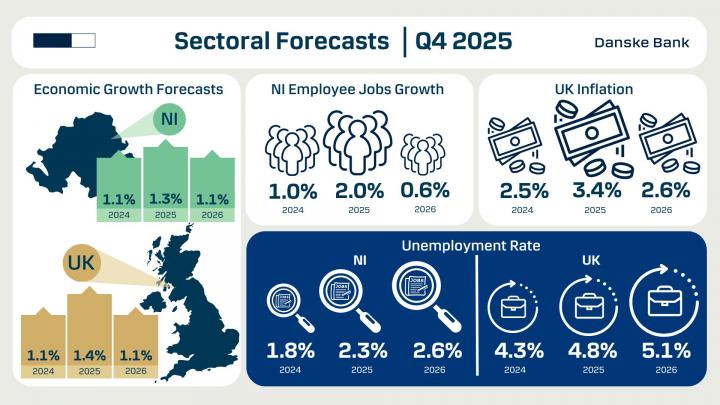
Danske Bank has slightly revised up its forecast for economic growth in Northern Ireland in 2025 but expects the rate of expansion to weaken in 2026 as inflation, taxes and uncertainty continue to weigh on the economy.
In its latest Northern Ireland Quarterly Sectoral Forecasts report, the Bank said it expects the local economy to grow by around 1.3% this year, a slight increase from its previous forecast of 1.1% and marginally below its forecast of 1.4% for the UK as a whole in 2025.
However, the Bank expects more muted economic growth of around 1.1% in Northern Ireland in 2026, in line with its UK forecast, as a range of factors hold the economy back.
Conor Lambe, Chief Economist at Danske Bank said: “Economic growth is expected to remain sluggish in both Northern Ireland and the wider UK in 2026. Inflation is projected to remain above target, higher taxes are likely to constrain activity and ongoing uncertainty will likely continue to weigh on the economy.
“However, we expect the gradual loosening of monetary policy to continue, which should provide some support to consumer spending and business investment, while higher government spending is also likely to contribute to economic growth.”
SECTOR OUTLOOK
Danske Bank said it expects the business services sectors in Northern Ireland to experience the strongest rates of expansion.
Of these sectors, professional, scientific & technical services and information & communication are projected to be the fastest growing, with GVA growth of around 2.0% and 1.9% respectively this year, and about 1.5% and 1.6% in 2026. The Bank’s forecasts for the administrative and support services sector are also relatively strong with projected growth of around 1.8% this year and about 1.4% next year.
Danske Bank is forecasting that output in the wholesale & retail trade sector will expand by around 1.7% this year and 1.3% next year. Growth in the accommodation & food service sector is projected to be slightly slower at around 1.5% in 2025, followed by 1.2% in 2026.
Activity in the construction sector is expected to expand by around 1.6% in 2025 and about 1.2% in 2026, while the manufacturing sector is forecast to experience weaker growth of around 1.1% this year and about 0.7% in 2026 in the face of high business costs, skills shortages and trade uncertainty.
LABOUR MARKET OUTLOOK
Danske Bank is now projecting that the growth rate of the annual average number of employee jobs in Northern Ireland will be around 2.0% in 2025. However, the pace of jobs growth is forecast to slow to about 0.6% next year.
Danske Bank is also forecasting that the unemployment rate in Northern Ireland will average around 2.3% in 2025 and about 2.6% in 2026.
Recent employee jobs growth in the construction sector has been strong and, as such, the Bank is forecasting that the sector will experience the fastest average employment growth for 2025 of around 5.3%, with a further 1.1% expansion projected for next year.
The outlook for employee jobs growth in 2025 across the business services sectors is mixed. The number of jobs in the information & communication sector is expected to contract by around 2.4% this year. However, Danske Bank is projecting that the average number of employee jobs in the administrative & support services and professional, scientific & technical services sectors will increase in 2025 and all three sectors are expected to outperform the economy-wide projection for employee jobs growth in 2026.
Recent jobs growth in the manufacturing sector has been steady, underpinning expectations of annual average employee jobs growth of around 1.4% in 2025. But employment growth is then projected to slow to about 0.2% in 2026, as the subdued trade and investment environment weighs on recruitment.
RISKS AND UNCERTAINTIES
Danske Bank said there are several risks and uncertainties around its projections.
Conor Lambe added: “Elevated uncertainty in the global economy remains a risk to the economic outlook. If trade or geopolitical uncertainty is more severe or lasts longer than anticipated, the UK and Northern Ireland economies could be more constrained than forecast.
“We expect inflation to average around 3.4% in 2025 and then fall to an average of about 2.6% next year, but there are risks to this forecast. Higher than projected inflation could lead to diminished consumer purchasing power and weaker prospects for economic growth. In addition, monetary policy may need to remain tighter than expected, which could further weigh on economic activity.”
Danske Bank Northern Ireland Quarterly Sectoral Forecasts
Sync NI's Autumn 2025 magazine explores how Northern Ireland is moving AI from pilot to production
This issue features exclusive insights from industry leaders on real-world AI implementation, responsible adoption, enterprise infrastructure, and how data-driven innovation is transforming businesses across the region.
Read the Big Data Special Edition free online →
Stay connected with NI's tech community:
Subscribe to our newsletter – Get the latest tech news, job opportunities, and events delivered to your inbox
Visit Sync NI – Your daily source for Northern Ireland technology news