Kieran Kelly can tell you the exact moment he knew the family business might not survive. It wasn't a boardroom, because there wasn't one. It was a butcher's counter in Lurgan, in the 1990s, when the BSE crisis tore through the UK's red meat sector and took the certainty of a generational trade with it. His father was a butcher, taught by his own father and sister before him. His mother was a nurse. Kieran left school and went straight into the shop, learning the craft from the ground up, from the farm gate to the counter. He assumed, reasonably, that this was the shape his working life would take.
BSE didn't end that assumption in a single conversation. It did something slower and, in its way, more formative: it made the question of long-term viability real for a family that had never had to ask it before. Kieran started teaching himself computing on the side, on a Commodore 64 his parents had bought him one Christmas, with no plan for it to become an income. It was a hobby that happened to exist at the exact moment his original path stopped feeling certain. He wrote a program for a video rental shop as his O-level project. He didn't know it yet, but the butcher's son had just found the other trade he'd spend his life in.
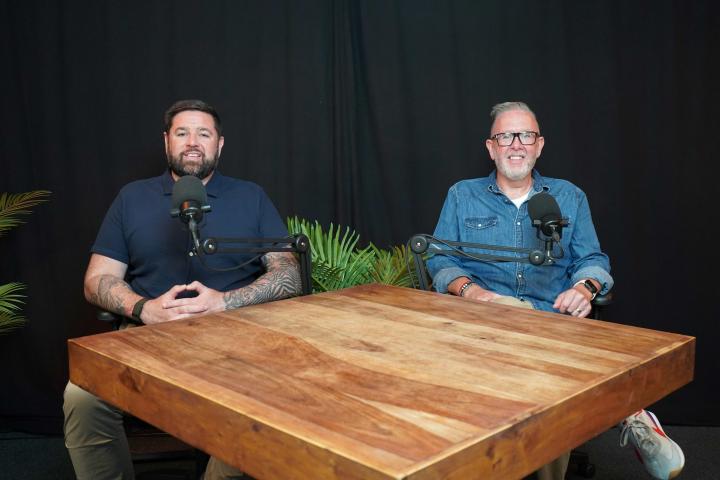
That is the origin story behind Ubloquity, the Belfast company Kieran now runs — a business built on blockchain technology that gives physical goods a verifiable digital passport, tracking their provenance, certification and history in a way no paper trail ever reliably could. It has moved freight across the Windsor Framework border in a live government trial, and it has protected one of the world's best-known musicians from having his guitars held up at customs. But the more interesting story, and the one Kieran kept returning to in a recent conversation with Ciarán May, founder of Natural Resilience, on The Natural Resilience Podcast, wasn't really about the technology at all. It was about what founding a company costs a person, and what it takes to survive that cost.
"I have put my family through the ringer," Kieran said, without being pressed on it, "because of my obsession and my desire to solve problems, because I can't switch off." It is not the kind of line founders usually offer up unprompted in a public interview. He didn't dress it up. His children, he said, have told him directly that he needed to sort himself out. His wife, in his own words, is "an absolute saint" for what she has absorbed while he chased one problem after another.
What makes the exchange worth relaying isn't just Kieran's honesty. It's a piece of practical wisdom Ciarán offered him in return — a framework built from Carl Jung's concept of the persona, the idea that identity is worn, not fixed, and that a person moves through different versions of themselves depending on the role the moment demands. Jung described it as a wardrobe: each morning, you take out a different hat. The founder hat goes on because the job requires it. You cannot wear the father hat, or the husband hat, at work; the register is wrong, the stakes are wrong, the person needed is wrong. The trouble is that the founder or business leader hat gets carried through the door unless something forces it off first.
Ciarán built himself a ritual to force exactly that. On a heavy day, before he gets home, he stops the car somewhere near the house and walks for five minutes. Not for exercise. To physically remove the founder hat before his own family have to deal with a man still wearing it. It works, he says, precisely because it isn't a decision he has to remember to make each time — it's a habit the body learns, which means it survives the days the mind is too tired to remember anything on its own. It's the kind of small, repeatable discipline that Kieran's own advisory board exists to surface: not a grand strategy, just the practice of taking the hat off before you're home.
The other half of what keeps Kieran upright is a phrase he returns to often enough that it has become something like a personal creed: it takes a village to raise a startup. Not a village in the abstract sense founders sometimes reach for when they want to sound humble. A specific, deliberately assembled advisory board, several of its members well known in Northern Ireland's tech scene, chosen for the discomfort they're willing to cause him rather than the comfort. "I've had extremely uncomfortable conversations with people from the advisory board," he said, "and the biggest growth comes out the other side of those really uncomfortable conversations."
He was candid, too, about a particular blind spot in how that advice lands. Some of the hardest truths he has had to hear were said first at his own kitchen table, by his own family, and he didn't listen — there is a version of founder self-belief that treats a spouse's concern as noise rather than signal. When an outside voice, someone on the advisory board, told him precisely the same thing, it landed instantly. He is honest that this isn't fair to the people closest to him. It is, he suggests, simply how it tends to work, and worth naming rather than pretending otherwise. Tech founders in particular, he warned, often make one of two mistakes: building no real network at all, or building one entirely within their own industry, which quietly curdles into an echo chamber that only ever reflects a founder's existing assumptions back at them.
Ubloquity itself emerged from a very specific national moment rather than a whiteboard idea in search of a problem. Kieran's background is in secure communications and cryptology — the discipline of making sure information can only be opened by the person holding the key — studied in part under Professor Chris Elliott at Queen's University Belfast, author of the UK's 2013 review into food supply chain integrity following the horsemeat scandal. When blockchain technology emerged in the following decade, Kieran recognised in it a way to strip intermediaries and administrative friction out of trade relationships, restoring something closer to the old, local trust economy: two people who know each other, trading directly, without a stack of paperwork standing between them.
The company's real proving ground came after Brexit, when the Windsor Framework exposed just how unready the customs and regulatory infrastructure was for moving goods seamlessly between Great Britain and Northern Ireland. Kieran and his team pitched a solution to UK, EU and Northern Ireland officials in 2020 and were given the chance to prove it. The trial itself has the texture of a story people will still be telling in ten years: in the middle of the pandemic, with the country in lockdown, Kieran told his wife they were going on a cruise. She asked where. "Liverpool," he said. They drove from Belfast, took the ferry across, then continued on through Wales, Birmingham and Scotland and back to Belfast — 1,300 miles in twenty-four hours, using defence-grade sealing technology to bond shipment data to a blockchain shared in real time with customs, DAERA, Border Force and HMRC. It worked. Ubloquity was formally registered in February 2021 and was generating revenue by that October, having raised £1.75 million to build it, in the middle of a global pandemic most companies were simply trying to survive.
READ MORE: Belfast Chamber Summit to Explore How Lessons in Leadership Can Help Boost Productivity
The clearest illustration of what all this actually means in practice, though, has nothing to do with freight lorries. It involves a guitar. Kieran worked closely with George and Aaron Lowden of Lowden Guitars on a project to give their instruments a digital identity of their own — a chip embedded in the headstock, bonding the guitar's materials, craftsmanship record and CITES certification (the international paperwork proving protected timber's legal origin) to the blockchain. The stakes of that project stopped being theoretical when Ed Sheeran, one of Lowden's most prominent players, nearly had a guitar detained at a border because its certification wasn't travelling with the instrument. With the chip in place, a phone held against the headstock now tells that guitar's entire story, from the tree it came from to the hands that shaped it. It was, by Kieran's account, a world first, and it was shown at AWS re:Invent in Las Vegas.
Asked what he'd tell a founder just starting out, Kieran didn't reach for a line about resilience or grit. He talked, again, about listening — about choosing carefully who is allowed close enough to challenge you, and building a village rather than assuming you can do it alone. He talked about protecting a founder's health as seriously as the balance sheet, admitting he hasn't always managed that himself. And he talked about not stopping at AI as a co-pilot, but making sure there's an actual human being in the picture too — a mentor, an ally, someone who has walked the path before.
It is, in the end, a story about a man who built a company to solve other people's trust problems, while working out, in real time, how hard it is to earn back a little more trust at his own kitchen table.

Read the Summer 2026 edition free online →
Stay connected with NI's tech community: