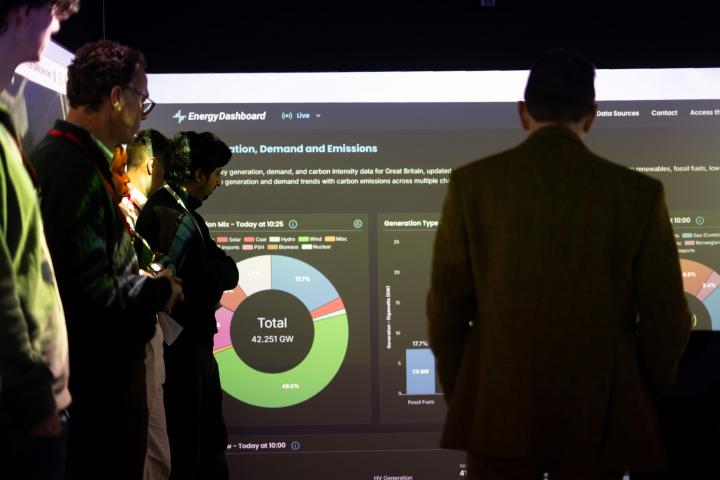
Considering ongoing geopolitical uncertainty, supply chain challenges and the growing need to innovate, digital twins represent a strategic capability for the UK with immense value for UK industry. Traditional operating models have long been reliant on static data and reactive decision making, leaving business leaders with a lack of insight and not enough resources at their disposal.
Digital twins offer dynamic, data-driven visual representations of real-world systems that enable the simulation, optimisation and prediction of operations in real-time. As such, they provide the foresight and insight necessary for business leaders to identify new opportunities, mitigate risk and meet demand which are essential in the context of unprecedented economic and commercial unpredictability.
At Digital Catapult, we deliver the UK Digital Twin Centre to accelerate the practical application of this type of deep tech innovation across industry and recognise first-hand the growing importance of digital twin solutions and their role as a critical capability for the UK economy.
Strengthening supply chain resilience
The nature of modern industrial supply chains is inherently interconnected across geographies and sectors, meaning that disruption in one region or industry can quickly cascade elsewhere. For example, recent developments in the Middle East have exposed the vulnerabilities and interdependence of global supply chains, with the Strait of Hormuz transporting 20 million barrels of crude oil and oil products every day last year, and its effective closure causing wide-ranging impacts to global markets and sectors.
Digital twins enable businesses and governments to simulate potential disruptions, testing scenarios, situations and responses before events occur, informing planning and preparedness. This includes modelling supply shortages, logistics delays, equipment failures, or shipping obstructions, enabling businesses and governments to identify vulnerabilities and reduce risk. Digital twins can also encourage operational optimisation, allowing business leaders to monitor systems in real time, predict maintenance needs and improve resource efficiency during periods of increased demand, strengthening UK industrial supply chain resilience.
With real-time data continuously informing decisions across supply chains, digital twins are proving to be of immense value in empowering business leaders to understand the options available to them and where to optimise operations to maintain commercial success.
The broader economic opportunity
As well as the operational benefits of digital twins for the UK, digital twins also serve as a vehicle to mobilise economic growth more broadly. Digital twin solutions have the potential to deliver significant productivity gains for businesses across a variety of different industries, enabling more efficient use of assets, infrastructure, and resources. By simulating resource-use, businesses can access rich data that can inform leaders on where cost-cutting measures can be implemented or how energy can be optimised to cut costs. Similarly, organisations can use digital twins for predictive maintenance, performance optimisation, or to deliver data-driven services, converging with other areas of deep tech innovation including artificial intelligence (AI), advanced connectivity and more.
By combining digital twin solutions with other areas of deep tech innovation, digital twins represent an opportunity to open new markets, develop new solutions and strengthen expertise that can be commercialised. As such, digital twins also represent a shift towards more data-driven industries, mobilising economic growth across key sectors including aerospace, defence, cybersecurity, maritime and more. A recent report for example, reported that the digital twin market is set to grow by nearly $32 billion from 2021 to 2026, demonstrating the economic value of the deep tech innovation, particularly in the context of its convergence with other technologies. The impact on operational efficiency as well as its role in mobilising economic growth across other sectors further highlights the value of digital twin capabilities for the UK economy.
Delivering the UK Digital Twin Centre to drive growth
Digital twin capabilities will be critical to long-term economic growth in the UK. The capacity to model and simulate a range of scenarios will be critical to weathering economic storms, supply chain disruptions and mounting uncertainty, improving the UK’s industrial supply chain resilience, and boosting its credibility in the eyes of international investors and global PLC. This is why Digital Catapult is harnessing the digital twin opportunity in collaboration with Shorts Brothers, Thales UK, and Artemis Technologies at the UK Digital Twin Centre, a £37.6million initiative funded by the Belfast Region City Deal and Innovate UK, to de-mystify digital twins and accelerate their application and adoption across industry. By convening capabilities between industry, startups and SMEs, and technological experts, real-world applications of digital twin solutions can be trialled and validated, developing new solutions that can be integrated into existing operational workflows.
The Centre is also proving the value of digital twins in supporting businesses to reduce the time it takes to develop and validate complex products and solutions. The prototyping process for new products or assets can be lengthy, often requiring long pilots, iterations, and adaptations to meet changing regulatory requirements. Digital twins enable businesses to prototype at pace, modelling and simulating adjustments to new products and creating scenarios to ascertain success or the need for continued exploration and development. This is why Digital Catapult has also partnered with the Centre for Modelling and Simulation (CFMS), to convene CFMS’ modelling capabilities with Digital Catapult’s digital twin expertise, strengthening the prototyping process and mitigating risk.
On the Digital Twin accelerator programme for example, Voxshell has worked on a HydroTwin Aerospace project that aims to create an AI-enabled digital twin platform to enable engineers to visualise real-time system behaviour, reducing prototyping costs. With supply chains stretched and under pressure to deliver products or new assets at pace, particularly in the context of aerospace, defence and security, digital twins are already proving to be a critical capability for the UK, becoming ever more important to unlocking economic growth in the years to come.
As economic growth remains a priority for government and industry alike, new capabilities that underpin market growth in the UK will be essential to unlocking new opportunities, opening markets and mitigating supply chain failures that could derail the country’s growth trajectory. This is why digital twins represent a key capability for the UK economy and will grow in importance as new digital solutions are applied to industry and equip the UK to be future ready. At Digital Catapult, we’re committed to accelerating the practical application of digital twins across industries and is why we continue to convene capabilities to make sure the UK capitalises on the digital twin opportunity and leverages the deep tech innovation as a vehicle for long-term economic growth.
Source: Written by By Katrina Thompson, Director of the UK Digital Twin Centre
Read the Spring 2026 edition free online →
Stay connected with NI's tech community: