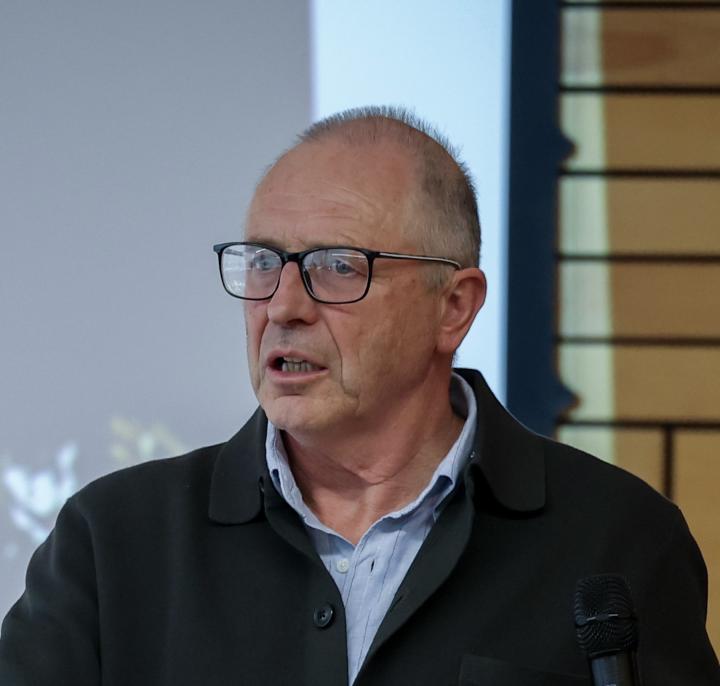
AI Expert Professor Alan Smeaton explores the future of care at Belfast’s Five Nations Care Forum, 23-24 November.
Artificial intelligence could help care workers spot gradual changes in an older person’s daily routines that might otherwise go unnoticed between homecare visits, Professor Alan Smeaton has told the Five Nations Care Forum in Belfast.
The leading AI researcher at Dublin City University said analysing patterns over weeks or months could give carers a fuller picture of how someone is managing at home, including changes in activities associated with preparing meals. He has carried out detailed research in this area.
“We were particularly interested not in the falls detection but in gradual behaviour change over a period of weeks or months,” he said.
READ MORE: Connected Health launches AI colleague to support homecare teams
Professor Smeaton, who is Emeritus Professor at Dublin City University, addressed care representatives gathering at the Titanic Hotel on 24 November. The Five Nations Care Forum brings together organisations representing care providers in Northern Ireland, the Republic of Ireland, England, Scotland and Wales to share experience and discuss challenges facing care homes and homecare services.
Northern Ireland’s Independent Health and Care Providers (IHCP) is hosting the event in Belfast.
Speaking at the event, Professor Smeaton described how sensors on household appliances, cupboards and doors can help identify changes in everyday activity.
Patterns in the use of a fridge, microwave or kitchen cupboards could provide clues about someone’s meal routines, giving a care worker useful information to explore during a visit.
He emphasised that the personal interaction would remain important, with carers continuing to have conversations about family and everyday life while arriving better informed.
Asked whether this type of monitoring would mean fewer carers, he said: “It’s not going to be a reduction in the number of carers. It’s going to be an improvement in what the carers can do.”
The high cost of fitting numerous sensors around an existing home has been a barrier, Prof Smeaton explained. However, he pointed to newer radar-based sensing approaches as a way to reduce reliance on individual devices attached to appliances and doors.
Beyond monitoring, Professor Smeaton identified AI assistants built around an organisation’s own information as an accessible application of the technology.
These systems can be designed to help staff find answers within a defined body of guidance and procedures. He argued that decisions about where AI would be most useful should draw on the experience of employees, with management supporting trial deployments.
“Allow people to try pilots, and we’ll all learn from them. And if they work, great. And if they don’t, we’ve learned,” he said.
“You don’t come in from the top and superimpose AI on everybody in an organisation because then there can be resistance.”
Professor Smeaton also believes advances in robotics could bring increasingly capable household helpers into people’s homes.
He described systems trained using data about human movement, helping robots learn tasks such as emptying dishwashers, folding clothes and ironing.
“I’m not going to put a figure on it in terms of number of years,” he said, describing the development as “a near-term thing”.
His examples concern assistance with domestic tasks, rather than robots providing personal or nursing care.
Conversational AI could also become more familiar as a source of companionship as it has in some other countries, although Professor Smeaton raised concerns about emotional attachment and the dangers of systems that tell people what they want to hear.
His presentation examined both opportunities and risks, including less visible AI working in the background and “agentic AI” — systems able to carry out tasks on a person’s behalf rather than simply answer questions.
For care workers, he said, understanding the technology’s limitations would be essential to helping shape its use.
“Find out what its limitations, its possibilities are, and then you can have a constructive conversation,” he said.
That does not require everyone to become a technical expert. Professor Smeaton compared it with learning enough about a car to use it properly.
“You don’t have to be a mechanical engineer to drive a car. But you have to have a certain level of car literacy. It’s the same with AI.”
IHCP Chief Executive Ms Pauline Shepherd said: “We are pleased to welcome colleagues from across the five nations to Belfast. This forum brings together organisations representing care homes and homecare services, giving us an opportunity to compare experience, discuss common challenges and learn from approaches being taken elsewhere.
“For IHCP, it is also an opportunity to put Northern Ireland’s experience into that wider discussion. We want to take practical ideas from these discussions, ideas that can help improve care here and inform our engagement with the Department of Health and those commissioning services.
“Professor Smeaton’s contribution will help us look beyond the headlines about AI and consider what it could mean for people receiving care and the staff supporting them. These are developments that care providers need to understand and help shape.
“We should be open to technology that helps people and supports staff. But introducing it successfully requires investment, training and the involvement of those who will use it. It cannot remove the need to fund care properly or invest in the people providing it.”

Read the Autumn 2026 edition free online →
Stay connected with NI's tech community: