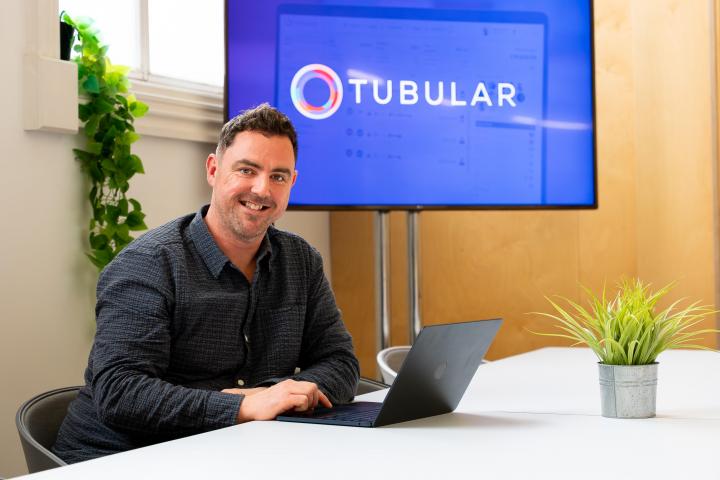
David Henderson discusses the chance opportunity that led him to buy and relaunch a software company before selling it to an American firm - and why he believes some of the hardest decisions in business are not starting something, but deciding when to stop.
For most business owners, a networking trip produces a few contacts and a handful of follow-up emails. Maybe even a few free pens. But for David Henderson, it eventually led to buying a software platform.
David, founder of Belfast-based
creative agency DHD, first encountered a CRM, Tubular, in 2015 while attending an event in Dublin. At the time it was an early-stage system developed by two founders from London he met at a trade-stand. His agency began using it internally and, over time, he built a working relationship with the team, regularly giving feedback on how it functioned in a real business environment.
“They were keen to understand how companies actually used it day to day,” he says. “We weren’t just users - we were helping them shape what it became.”
The platform evolved into a customer relationship management system designed to track opportunities and sales pipelines, and DHD relied on it heavily. David’s company even created explainer animations for it. But several years later, after a meeting in London, he returned to Belfast and tried to log in, only to discover the system had disappeared.
The development agency behind the platform had been acquired by a US company and the software had effectively shut down.
“I contacted the founders thinking it was a technical problem,” he says. “Instead they told me they'd been bought over and no longer had time to continue it.”
At first, he dismissed the idea. David ran a brand agency, not a tech company. But he knew several businesses depended on the system and believed it still had value. After months of consideration and advice from Belfast’s startup community, he started to think seriously about buying it.
“It was one of those moments where you realise an opportunity might only exist briefly,” he says. “I thought, if I ignore this, I’ll always wonder what would have happened.”
Recognising the technical challenge involved, David partnered with Belfast software developer Jack Spargo, who became the CTO. Together they rebuilt the infrastructure, secured hosting and re-established the platform as a functioning business.
“It quickly became real,” David says. “You’re responsible for people’s data, security, and success. This wasn’t a website; it was a whole company.”
They contacted around 25,000 former Tubular users to let them know the CRM was back, thinking they'd see a huge spike in subscriptions overnight. Six people subscribed again.
“That was probably the reality check,” he jokes. “You realise a software business is completely different to a consultancy. In a service business you build relationships. In software, scale matters.”
The pair recruited sales support, met former customers and relaunched the system, but the commercial model proved challenging. At around £30 per user per month, growth required significant time and focus, while Henderson’s design agency was expanding.
“I had committed two days a week to it, but DHD was growing and demanding more attention,” he says. “Eventually you have to decide where your energy should go.”
After roughly three years, they faced a choice - seek investment and scale, continue part-time, or exit. David also believed the market was about to shift rapidly with advances in artificial intelligence.
“We knew software development was going to change,” he says. “Products that once took years could soon be built far faster. We had to make a clear decision.”
They chose to sell.
The company was listed on an online marketplace for software acquisitions. Soon after, an American business operating in the video production sector approached them. The buyer understood the platform’s niche use and planned to integrate it with its own product suite.
David was attending a conference in Portugal when negotiations began. “I thought it was an introductory call and suddenly they were discussing numbers,” he says. “We took ten minutes off the call just to process it all - for us, it was the moment on Dragon's Den when the pair walk backstage for a quick whisper!"
A deal was agreed and completed shortly before Christmas 2025. “It wasn’t a retire-to-the-beach exit,” he says. “But it was absolutely worthwhile. The learning alone was invaluable.”
The experience, he says, changed how he views business decisions. Buying the platform required accepting uncertainty; selling it required recognising limits.
“People think entrepreneurship is always about persistence,” he says. “But sometimes the right decision is stepping away. The house doesn’t win every time, but it does most of the time - and you have to make choices for the greater good of your main business.”
He believes the lessons now influence how he runs DHD, from evaluating projects to managing growth and risk.
“You can study business for years,” he says. “But running, overcoming the challenges, and ultimately exiting a company teaches you things no course can.”
His advice to others considering a similar step is straightforward.
“Watch for opportunities as they don’t hang around,” he says. “And be honest with yourself. Starting something takes courage, but knowing when to move on takes just as much.”