

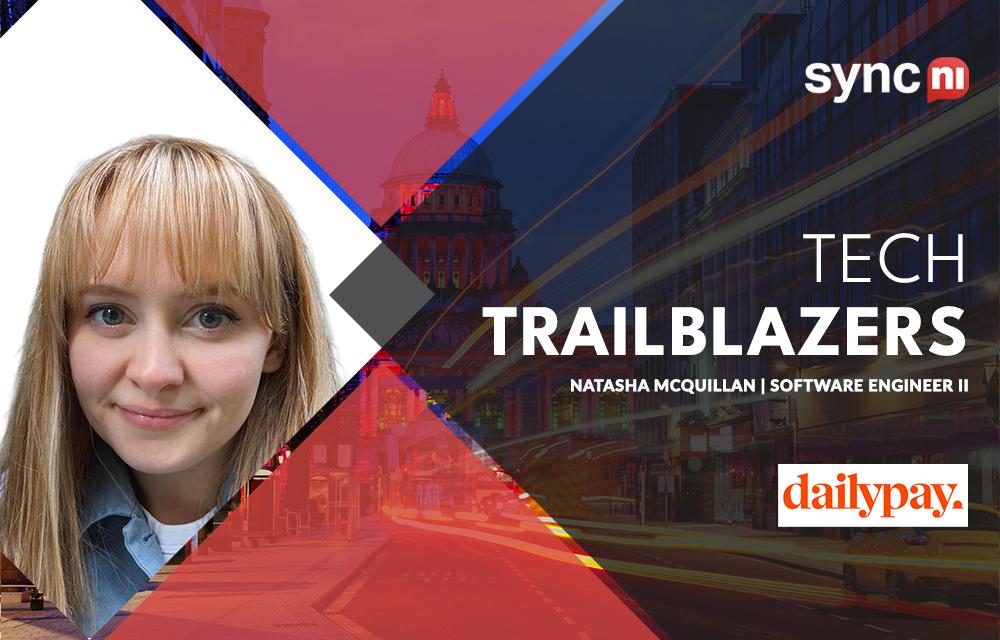
Natasha McQuillan has traded one creative craft for another. After spending her early career in film and TV production, she made an unexpected pivot during the pandemic by teaching herself to code. Today, she's a Frontend Engineer at DailyPay in Belfast, building financial wellness tools that help people understand and manage their money. We sat down with Natasha to talk about her unconventional path into tech, why making complex things feel simple is her favorite challenge, and what she'd tell anyone considering a similar career shift.
What are you currently working on?
I work on the financial wellness side of our consumer app, creating features that allow users to understand their spending and make their money stretch further. It’s all about helping people grasp their current financial situation to better plan for the future. I’ve had the chance to work on a mix of brand-new projects as well as expanding our existing wellness tools.
What inspired you to join this company in particular?
Two main factors brought me here. First, I wanted a culture that valued design as well as code. Knowing there was a dedicated UX team (with some designers on site in Belfast) was a huge selling point. I wanted an environment where Engineering and Design were able to collaborate. Second, I wanted to find the technical middle ground. I had worked on apps in their infancy and massive legacy systems, but DailyPay offered the perfect balance. Established enough to offer mentorship and structure, but agile enough that I could still own my work and see the impact.
READ MORE: Tech Trailblazer: Stevie Preston, Site Reliability Engineer at DailyPay
Did you always want to work in this industry (tech)?
No. My path into tech wasn't linear, but looking back, it makes perfect sense. I’ve always been drawn to creative industries and I could argue I still work in one, just with a different set of tools! I studied art and fashion, worked in costume, film production and theatre. When the pandemic hit and I was furloughed, I couldn’t sit still. I started learning to code to keep my brain active. My original goal was to build a simple app to help solve a problem at my job at the time. IIt turns out that ‘simple’ app was more
complex than I expected. Also it turns out that I really enjoyed coding. That curiosity led me to quit my job, enroll in a Master’s conversion course at Queen's, and never look back. I never got round to finishing that app though.
What’s your favourite part about your work?
I love the challenge of making something complex feel simple. Frontend engineering is incredibly tangible. Everyone interacts with it and can instantly feel the difference between a clunky experience and a seamless one. My favourite part is taking all the heavy lifting, messy logic, edge cases and abstracting them away. If I’ve done my job right, the user never sees the complexity. They’ll see an interface that feels effortless and obvious.
What would you say to other people considering a job in this industry (tech)?
It’s really not as scary as it seems. Coming from a non-tech background, I know how intimidating the wall of terminology and new skills can look. Imposter syndrome is real, but it’s also temporary. If you stick with it, the chaos starts to make sense, and it all becomes second nature
Sync NI's Spring 2026 magazine explores innovation and collaboration transforming Northern Ireland's technology ecosystem
This issue features exclusive insights from industry leaders on AI transformation, cybersecurity evolution, legal technology innovation, and how strategic partnerships between academia and business are accelerating real-world impact across the region.
Read the Spring 2026 edition free online →
Stay connected with NI's tech community:


