Every weekday morning for the best part of eight years, a PhD student met his supervisor for coffee at half past eight. They walked to the same coffee shop and talked about the work. The supervisor, Professor Bernie Smith, was by then a world heritage site assessor who flew around the globe advising on UNESCO listings — a man with nothing left to prove and nothing to gain from the time he gave a young researcher who'd struggled badly at school and scraped into university without much confidence at all. He gave it anyway. He pushed his student to publish, to speak at conferences, and once handed him a keynote slot in Cyprus rather than take it himself.
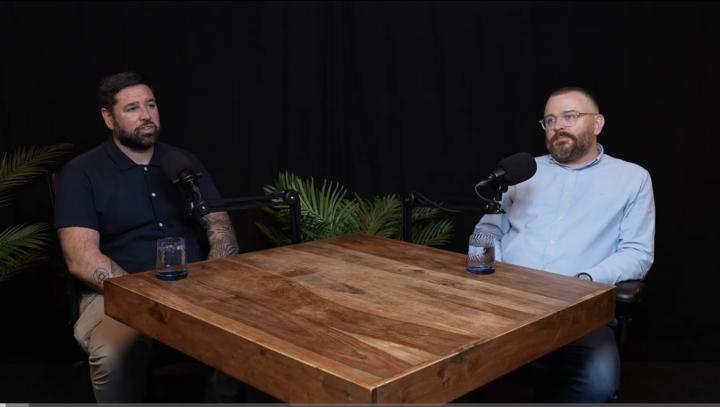
That student is Dr Stephen McCabe, now Executive Director of Momentum One Zero, the innovation centre inside Queen's University Belfast built to help deliver the Belfast Region City Deal — on paper, a leadership role built on committees, funding structures and public accountability. Any of that would make an easy headline. But the more interesting story, and the one Stephen kept returning to in a recent conversation with Ciaran May on The Natural Resilience Podcast, wasn't really about the institution at all. It was about what it actually took to become someone capable of running it.
Bernie Smith died in October 2012, and the years that followed were, in Stephen's own words, shaped by “shattered dreams” and a grief he still visibly carries. What he didn't fully realise at the time was that the pressure of that period — funding his own research, losing the mentor who'd anchored his professional identity, and years earlier as a researcher “running on fear,” trying to be the best in the world at something while never quite separating himself from the work — was building toward something more serious. “I had very significant mental health problems,” he said plainly. “Actual clinical depression, over — I don't know — it could have been four years, before it was diagnosed and dealt with.” He tried, more than once, to explain it to his own GP. It didn't land. “It's probably just the way I am,” he told himself. What changed things wasn't a better version of that conversation. It was his partner coming to the appointment with him and describing, in plain terms, what it was actually like at home. The GP understood immediately. Medication and therapy followed, and Stephen describes the effect in a phrase that's stayed with him since: his mind had been let out of jail. He hadn't realised, until it lifted, that low mood wasn't supposed to be the baseline.
What he built afterward is deliberately unglamorous. Breathing exercises most mornings, before the day gets away from him. A short list of words — courageous, ambitious, authentic, compassionate — written small on the whiteboard in his office, not for show, but as a genuine daily check against real decisions. “Anytime I'm making decisions that aren't driving me towards being that kind of person,” he said, “I better stop and take a moment.” It is not, he's careful to say, a personality trait he was born with. It's the outcome of a long process of knowing himself through dealing with mental ill health — a system, built deliberately, not a disposition.
That system is now doing quieter work underneath a much bigger project. Momentum One Zero sits at the convergence of cybersecurity, AI and wireless technology, translating intellectual property out of Queen's University into commercial value through a team of around thirty engineers, who take academic ideas and build them into working demonstrators a company can take to market. It exists because of a UK Treasury-funded package: the Belfast Region City Deal, a billion-pound investment into the Belfast region over fifteen years, from the UK Treasury, the Northern Ireland Executive and the City Deal's own council and university partners. One of Momentum One Zero's collaborations, working on the a cyber-physical security project, has already led the partner company to commit to new jobs in the Belfast region — a concrete answer, Stephen argues, to the assumption that AI-driven efficiency only ever costs jobs rather than sometimes creating them.
None of that, Stephen is candid, has been simple to deliver. Processing that scale of public money across that many stakeholders, and building genuine trust between partners who'd never worked together before, has at points been genuinely hard. “I think it's only because I have learned the resilience strategies that I've learned,” he said, “that I've been able to just stick the course.” It is the same operating system — the breathing, the whiteboard, the willingness to name a decision honestly rather than let the day carry him along — doing its work at institutional scale rather than personal.
He is, by his own admission, an optimist about what all of this adds up to for Northern Ireland. He talks about a culture of doing a lot with a little, of a place that has had its back against the wall long enough to become genuinely agile rather than merely resilient in theory. He tells a story about an FDI company's US clients specifically asking for projects to be delivered out of the Belfast office, because the trust in that capability is already there. What Stephen keeps returning to, though, is a caution against telling only that story. “For every period we're developed,” he said, “something is taken away from us.” Growth has a cost, and naming it plainly, rather than only celebrating what it built, is exactly the discipline his own recovery taught him first.
It is, in the end, a story about a man trusted to hold together a very public, very complex act of institution-building, who is candid that he can only do it because of a private, much harder piece of work he had to do first.
LISTEN TO THE FULL CONVERSATION
YouTube: https://youtu.be/GhW-dhYrBBw?si=eYMKRlaXo7QwUnxF

Read the Summer 2026 edition free online →
Stay connected with NI's tech community: