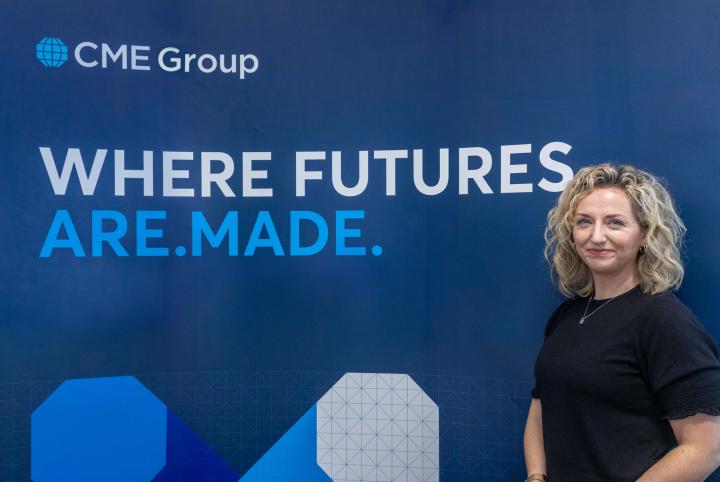
Sync NI sat down with Rachel Nixon, Senior Director of Product Management at CME Group, to talk about her journey into fintech, what it's like working on infrastructure that moves billions in trades daily, and the advice she'd offer to the next generation of women building careers in tech.
How would you describe your pathway into fintech, and what's kept you passionate about this sector?
I took a circuitous route into fintech and I certainly didn’t see myself in a role like this while I was doing my English Literature degree! After I completed a Masters in Marketing from Ulster University, I was lucky enough to land a job in Bank of Ireland and from then I’ve always worked at the intersection of business, data and technology. Fintech is one of the few sectors where those three sectors constantly collide in very real, high-impact ways.
What drew me in initially was the scale and complexity of the problems. Financial markets provide critical infrastructure and when they work well most people never notice them, but they underpin global economies. Being able to work on markets platforms that need to be resilient, secure and performant at all times, such as market data systems, is both challenging and incredibly motivating.
What’s kept me passionate is how quickly the sector, and the technology that drives it, continues to evolve. Over the last few years we’ve seen an acceleration in cloud adoption, data-driven decision making and now, of course, AI. Fintech forces you to think long term about trust and stability while still innovating at pace. That balance between innovation and responsibility, is what keeps the work meaningful to me.
As Senior Director of product management working on infrastructure that moves billions in trades daily, how do you prioritise your day?
Prioritisation at the scale required at CME Group is less about task lists and more about judgement. When you’re responsible for systems that operate at a global scale, the most important questions are around where your attention can add the most value today.
I usually anchor my day around three things. First strategic clarity, and making sure that my teams understand the “why” behind what we’re building, that it’s solving a genuine pain point and isn’t just ‘tech for tech’s sake’ and how all of that connects to business outcomes.
Second is delivery and risk. A big part of my role is removing blockers, solving ambiguity and ensuring we’re making sound trade-offs between speed, resilience and quality.
And thirdly, and most importantly, people. I invest time in my teams because strong products come from strong, empowered people.
What technologies or methodologies are making the greatest impact on your role at the moment?
Without question, data and AI are having the biggest impact right now and not just as technologies, but as capabilities that change how decisions are being made across the organisation.
On the technology side, modern data platforms, real-time analytics and large language models are opening up new ways to understand customer behaviour, operational risk and system performance. This shift means that we’re moving more towards embedding intelligence directly into workflows
From a methodology perspective, product-led thinking has been key. Moving away from static roadmaps towards outcome-driven delivery allows teams to respond more quickly to change. Strong discovery practices, close collaboration between product, engineering and stakeholders and a relentless focus on value all matter much more than rigid processes.
How would you describe CME Group as a place to work in terms of personal support and career development?
CME Group has been a place where I’ve been encouraged to grow, not just vertically, but in terms of breadth and impact too. There’s a strong culture of trust and accountability, which gives people the space to take on complex challenges and learn from them.
From a career development perspective, what’s stood out to me is the emphasis on long-term capability building. Whether that’s leadership development, technical depth or exposure to different parts of the business, there’s real support for people who are curious and proactive about their growth.
On a personal level, flexibility and understanding matter too. CME Group is currently supporting me through a PhD, but I also have a busy family life with three young girls and a very needy bulldog! Being able to balance demanding work with life outside is essential, and that support makes a tangible difference.
What are the core technical skills and personal characteristics that CME Group currently wish to attract into the business?
Technically, we look for strong foundations. We want people who understand data, distributed systems, cloud technologies and modern engineering practices, but of course, technical skills alone aren’t enough.
Equally important are curiosity, judgement and the ability to work through ambiguity. The problems we’re solving don’t come with neat answers, so we value people who ask good questions, challenge assumptions and think holistically.
Communication skills matter enormously as well. Being able to translate complex technical concepts into clear, meaningful insights is critical in a global organisation where technology, business and customers are tightly connected.
As a senior female leader working in tech, what advice would you offer younger women seeking to forge a career in the sector?
My biggest piece of advice is not to wait until you feel “ready”. Confidence often comes after you take the step, not before it. So say yes to opportunities that will stretch you, even if you don’t tick every box.
Your network is also crucial, so build it early and build it far-reaching. Seek out mentors who will give you advice and sponsors who will mention your name in rooms you’re not in. Seek out those leaders, male or female, who are willing to put their social capital behind your talent. Seek out environments where your voice is genuinely heard- you shouldn’t have to change who you are to succeed.
Finally, remember that leadership doesn’t have to look one particular way. There’s room in tech for different styles, perspectives and paths. The industry is stronger for that diversity, and we need more women helping to shape what comes next.
Sync NI's Spring 2026 magazine explores innovation and collaboration transforming Northern Ireland's technology ecosystem
This issue features exclusive insights from industry leaders on AI transformation, cybersecurity evolution, legal technology innovation, and how strategic partnerships between academia and business are accelerating real-world impact across the region.
Read the Spring 2026 edition free online →
Stay connected with NI's tech community: