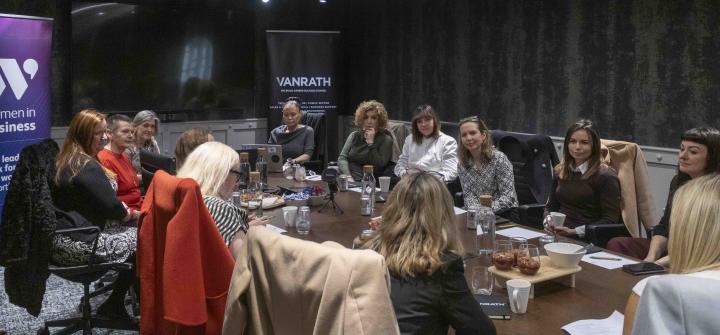
Lorraine Acheson, Managing Director at Women in Business invited a collection of senior female tech leaders to discuss strategies for attracting more women into tech careers emphasizing the need to start early and challenge outdated stereotypes
Hosted by Barbara McKiernan, Managing Director at recruitment firm VANRATH at Custom House in Belfast, technology leaders gathered to confront a persistent challenge: how to increase female representation in an industry that continues to be overwhelmingly male-dominated.
Despite years of diversity initiatives, women still represent only 20-30% of tech workforces, with even lower representation in technical leadership roles. A recent gathering of executives, educators, and entrepreneurs revealed that change is possible when we are willing to challenge convention and start much earlier than we ever imagined.
One senior teacher shared a sobering discovery, when her school hosted a technology competition across all age groups, primary school and early secondary years saw strong participation from girls. But at ages 14 and up they actually received ‘Zero’ female entries.
This revelation sparked discussion about a critical vulnerability window for girls between ages 8 and 13, when societal pressures and stereotypes can derail budding interest in STEM subjects. Multiple participants noted how girls at this age often begin "dumbing themselves down" to appear less intimidating to their peers.
In response, an event has been organised in early 2026 for approximately 200 local students that will specifically celebrate women entrepreneurs. These same young people will then be invited to create TikTok videos highlighting female success stories in technology. The idea is to utilise a media platform young people actually engage with rather than rely on traditional career materials that often go ignored.
Fatima Beach, Chief People Officer, SpiderRock Technology Solutions, as invited speaker, shared how her organization increased female representation from 8% to nearly 32% globally. Her approach centred on four pillars: early awareness, higher education engagement, workplace inclusion, and surrounding oneself with "fearless allies."
Another suggestion that directly challenges conventional wisdom about when to begin tech education involved introducing STEM concepts through play-based learning modelled on existing Montessori methods. In this scenario building blocks become engineering and mixing colours becomes science, and all this before children even enter formal schooling. A systemic failure to tackle this issue has created problems further downstream.
"We can't just wait until they're in grade school," as one participant emphasized. "During my recruiting at universities, I would receive stacks of resumes from international female students, but only a small pile from domestic women. In countries like India and the Philippines, students choose engineering at age 12 and follow that path. That's why we see 50-50 gender splits in tech roles there."
Her company has implemented monthly "Women in Tech" discussion sessions, resume workshops for interns, and emotional intelligence training focused on overcoming negative self-talk, a barrier she believes holds many young women back from advocating for themselves.
The conversations also moved to address the unspoken ‘Interview Problem’ that frequently occurs during the recruitment process.
One technology governance specialist who frequently hires for senior technical positions shared a frustrating pattern. Despite receiving huge volumes of female applications for roles like senior security infrastructure engineers and infrastructure team leads, more than half don't make it through initial screening. Those who do are often unprepared and fail to display the same levels of confidence of their male counterparts.
"Women just do not promote themselves enough, especially young women," she observed.
The group discussed whether the problem resides solely with the candidates, or do interview processes themselves need rethinking?
One company leader revealed they recently introduced AI-powered interview analysis that provides feedback to interviewers about language use and potential gender bias.
"It's actually changed how some senior people have been interviewing, especially when talking with women," she noted. Her company has achieved 33% female representation in their UK office, though most women work in non-technical roles. Interestingly, their Manila office maintains a precise 50-50 split.
In one thought provoking exchange one Chief People Officer asked everyone to stand and look around the room. "If you don't uplift each other, you are your own worst enemies," she said. "We may blame society, but we need to stop competing and start collaborating."
Several participants acknowledged that having male allies has been crucial to their success and stressed the importance of maintaining professional networks. Nurturing these networks are essential as former colleagues often reconnect throughout their careers, creating support systems that transcend individual companies.
The conversation also touched on the need to educate boys alongside girls. The teacher's planned April event will include male students precisely for this reason, recognizing that future workplace cultures depend on everyone understanding and valuing diverse perspectives.
Participants agreed that meaningful change requires reaching beyond their own organizations. Several companies already bring young people in for shadowing experiences, but one executive challenged the group to think younger suggesting vouchers for coffee shops or other appealing incentives for 15 and 16-year-olds who visit tech offices.
"Some of these students have never been in an elevator," she said, referencing her work with inner-city schools through a project that brings disadvantaged students into corporate environments.
The discussion revealed another critical gap, specifically a lacking in many parents' understanding of technology careers for females. A recruitment specialist recounted visiting a regional college where parents seemed genuinely surprised to learn about career opportunities for daughters in tech, not just sons.
A tech entrepreneur emphasized the need for children's books and early educational materials that celebrate women in technology. "Little boys see fire engines and say 'I want to be a firefighter.' We need those same inspiration points for girls in tech," she said.
As the roundtable concluded, participants agreed there was still much work to be done if the disparity of female representation in the tech sector was to be rebalanced. Recommendations included creating internal mentorship programs; opening offices to younger students;, involving more team members in educational outreach and reconsidering how job descriptions and interview processes might inadvertently discourage female applicants.
The consensus was clear: achieving gender parity in technology isn't just ethically right, it's a business imperative. Research consistently shows that diverse teams drive innovation and this in turns produces greater financial performance and increased profitability for the organisation.
Yet perhaps the most important takeaway came from one executive's challenge to the room: "If you're in tech, mentor someone. If you're hiring, open doors earlier. Don't rely heavily on AI screening because you'll miss that unicorn candidate. If you're in leadership, make inclusion non-negotiable. And if you're looking for inspiration, surround yourself with uplifting allies."
The work continues, but with industry leaders speaking this candidly and committing to concrete action, the tech sector may finally be positioned to turn aspiration into measurable change. It can simply start with one mentorship, one classroom visit and one inspired young woman at a time.
Sync NI's Autumn 2025 magazine explores how Northern Ireland is moving AI from pilot to production
This issue features exclusive insights from industry leaders on real-world AI implementation, responsible adoption, enterprise infrastructure, and how data-driven innovation is transforming businesses across the region.
Read the Big Data Special Edition free online →
Stay connected with NI's tech community:
Subscribe to our newsletter – Get the latest tech news, job opportunities, and events delivered to your inbox
Visit Sync NI – Your daily source for Northern Ireland technology news