Trust between machines is no longer a theoretical problem. As autonomous systems take on more of the decisions once made by people, the question isn't whether we should trust them, but how they establish trust with each other in the first place — particularly when there's no human watching. Few companies understand that better than ANGOKA, a Belfast-based cybersecurity company that has spent the past seven years solving exactly that problem.
ANGOKA was founded on the conviction that as connected machines proliferated, the security infrastructure protecting their communication simply wasn't fit for purpose. The company cut its teeth in the automotive and autonomous vehicle sector, tackling how to establish trust between machines that cannot rely on human oversight, constant connectivity or centralised control. That early work produced sixteen patents and put ANGOKA's technology at the heart of more than half of the UK's Smart Mobility programmes, before extending into uncrewed aerial platforms and defence applications.
That trajectory has culminated in ANGOKA MeshShield™, a secure communication solution for robotic and autonomous systems. It dynamically builds self-healing, quantum-secure mesh networks across any combination of data links, including untrusted channels, underpinned by a hardware root-of-trust that gives every device an identity that cannot be spoofed, cloned or compromised at the network layer.
READ MORE: Cracking the Code on Rogue AI: What Really Happened at Hugging Face
A Six-Year Partnership
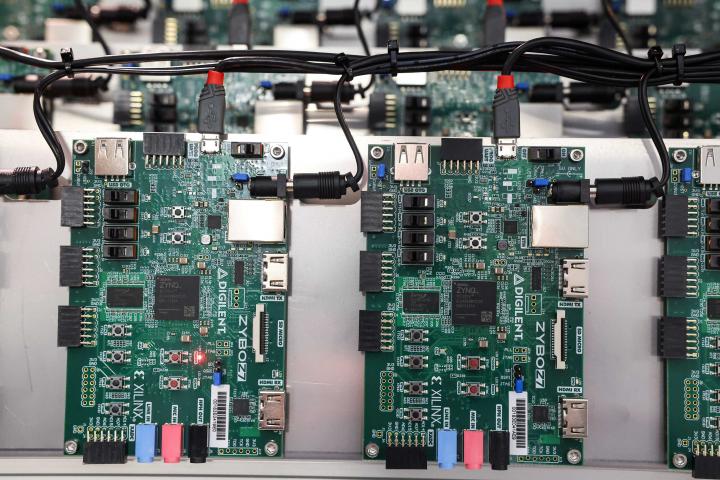
Queen's University’s Centre for Secure Information Technologies (CSIT) has been part of ANGOKA's technology development for six years. Their latest collaboration, delivered through CSIT’s Cyber-AI Hub programme*,set out to strengthen the hardware-rooted device identity at the core of MeshShield™ by deriving a unique fingerprint from the hardware and software parameters available on an embedded device.
Throughthe Cyber-AI Hub project, CSIT carried out a systematic literature review across the field of device identification, mapped possible characteristics across embedded microcontrollers, and analysed the security qualities and potential attack vectors of each. With CSIT’s researchers and engineers working alongside the company, the project resulted in translation of research findings into an application that ANGOKA's team could integrate into MeshShield™.
READ MORE: From Patient Stories to Patient Safety
Project planning ensured that CSIT's project team and ANGOKA's product development could run in parallel rather than in sequence, so the technical approach and its practical application were developed in tandem. This led to a rapid prototype development over the lifetime of the project.
CSIT is located within Momentum One Zero, one of three flagship Innovation Centre’s at Queen’s University Belfast,which is currently undergoing a £70M extension funded through the Belfast Region City Deal investment. Momentum One Zero is working to scale CSIT’s proven model of effective industry collaboration into other sectors where Queen’s can contribute world leading expertise, including Health, AgriFood and Fintech applications.
* The Cyber-AI Hub is funded by the UK Government through the New Deal for Northern Ireland. The funding is delivered on behalf of the Northern Ireland Office and the Department for Digital, Culture, Media and Sport by Innovate UK.

Read the Autumn 2026 edition free online →
Stay connected with NI's tech community: