While most firms in Northern Ireland remained profitable in Q2 26, a significant minority were under pressure. Survey findings published today (Friday) by NI Chamber and Queen’s University show that the strain falls most heavily on the smallest firms. Just 62% of micro firms (fewer than 10 staff) report trading well or reasonably, against 88% of small firms and 89% of those with 50 or more staff. Micro firms are also more than three times as likely to be just covering costs or struggling.
Overall, 83% of firms who responded to this survey report trading well (37%) or reasonably (46%). 13% are just covering costs and a further 4% are struggling, meaning around one in six firms (17%) is at best breaking even.
Prices and Costs
Price pressures remained elevated across both sectors in Q2 26 and in manufacturing, have re-intensified. Manufacturing price expectations jumped to +68, their highest in over a year, while services held steady at +49.
The persistence of price increases reflects continued cost pass-through. These pressures are being driven primarily by internal cost factors, with labour costs remaining the dominant pressure in both sectors.
Confidence diverges
Confidence diverged in Q2 26. In services it held broadly steady, while in manufacturing it weakened materially, with profitability expectations declining for a sixth consecutive quarter to at or below zero.
Investment intentions remain positive and ahead of most UK regions, but cautious and volatile. Northern Ireland is among the leading UK regions on both plant and machinery and training investment in both sectors. These balances are positive in Northern Ireland while running negative nationally, although there is no clear sign of acceleration.
Recruitment holds up
Hiring intentions held up but again, diverged by sector in Q2 2026, with services balances firming to +29 while manufacturing eased to +20. Both remain only modestly above their pre-pandemic norms and well below the 2021–22 peaks, pointing to steady rather than strong employment growth.
At the same time, a high proportion of firms are actively trying to recruit. Recruitment activity in manufacturing is at or near the highest level recorded in the series at 90%, while services eased slightly to 75%.
However, this is not translating into stronger employment growth. The gap between high recruitment activity and more modest employment expectations reflects hiring for replacement rather than expansion.
Strong UK position
Northern Ireland ranked strongly across UK regions in Q2 2026 and its relative position has strengthened.
In services, performance is particularly strong, with Northern Ireland recording the highest balance of the twelve UK regions on seven indicators including export sales, export orders, employment, recruitment activity and cashflow. In manufacturing, strength is more concentrated, but Northern Ireland still ranks among the leaders on investment and recruitment activity and among the top regions on jobs and exports.
The relative weaknesses are domestic demand and confidence, where Northern Ireland sits closer to the middle or lower end of the regional distribution, and labour availability, where the region reports among the tightest conditions in the UK.
Impact of the Iran Conflict
The conflict involving Iran, and the resulting energy and market volatility, has had a clear negative effect on Northern Ireland businesses. Two-thirds of firms (68%) report a negative short-term impact on their outlook, split between 57% somewhat negative and 11% very negative, while a quarter report no significant impact.
The impact is broad but its severity falls most heavily on the smallest firms. While larger firms are marginally more likely to report being affected at all, micro firms are far more likely to be hit hard - 22% report a very negative impact, which is around three times the rate of larger firms.
Higher energy, fuel and operating costs are by far the most cited effect, reported by 69% of firms. Increased uncertainty (39%) and supply chain disruption (37%) follow, with reduced demand, margins and investment each cited by around a third. Just 5% report no impact on any aspect of their business.
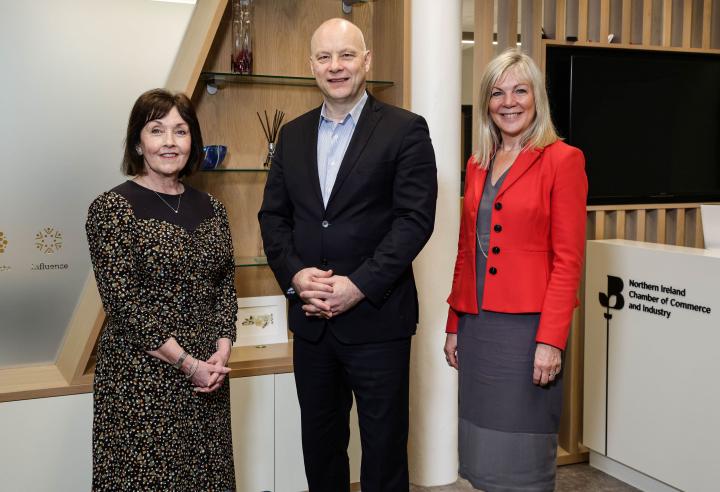
Commenting on the survey findings Suzanne Wylie, Chief Executive, NI Chamber, said:
"Northern Ireland businesses continue to demonstrate resilience in a challenging economic environment. Firms here are outperforming many other UK regions on investment, recruitment and exports, highlighting the determination of our business community to continue investing and growing despite ongoing uncertainty.
"However, the findings also underline that growth remains fragile. Domestic demand is weak, cost pressures remain intense and confidence in the manufacturing sector has deteriorated. While many businesses are continuing to perform well, that resilience is not being experienced equally across the economy.
"One of the clearest messages from this survey is the impact that instability in the Middle East is having on firms here at home. The impact is particularly acute for manufacturers and for our smallest businesses, which often have the least capacity to absorb external shocks.
“Overall, the survey points to a growing challenge for micro businesses. Almost four in ten micro firms are either just covering their costs or struggling, while more than one in five report that the conflict in the Middle East has had a very negative impact on their business. These firms are the backbone of our local economy and employers in communities right across Northern Ireland.
“Businesses have shown remarkable resilience, but resilience alone is not a strategy for growth. Northern Ireland needs urgent progress on the long-standing barriers to competitiveness, including skills shortages, planning delays, wastewater capacity constraints and energy costs. By addressing these challenges and providing greater certainty for business investment, we can ensure that firms of all sizes are equipped to grow, create jobs and strengthen Northern Ireland's economic performance in an increasingly uncertain world."
Professor Richard Ramsey, Professor of Practice at Queen’s Business School, added:
"The latest survey is something of a mixed bag. Whilst Northern Ireland continues to outperform most of its peers in Great Britain, all 12 UK regions continue to struggle in one form or another. The local economy continues to be buoyed up by the relatively strong economic performance of the Republic of Ireland economy. The latter is helping to offset weak domestic demand conditions particularly within the services sector. External markets continue to support strong service sector activity and confidence looking ahead. Conversely, the manufacturing sector is less optimistic about the challenges ahead.
"In the climate of ‘tariffs on, tariffs off’; and ‘ceasefires on, ceasefires off’; uncertainty remains a given. Meanwhile for both services and manufacturing, skills shortages and cost pressures appear to be switched on permanently.
"On the cost front, ‘Warflation’ is impacting on input costs, notably within commodities and energy. However, much of the newly embedded cost pressures are ‘self-inflicted’, stemming from UK policy as opposed to global factors. Peace in the Middle-East and a re-opening of the Strait of Hormuz will not bring labour costs down. Similarly, UK and NI businesses will continue to face some of the highest electricity costs within Europe. It is the relative cost, rather than the absolute cost, that affects competitiveness.
"In light of the above, the profitability squeeze is set to continue. The latest survey notes that profitability expectations have declined for the sixth successive quarter. Businesses are waiting to see what the new incoming Burnham government will mean for the UK and Northern Ireland. More tax, more devolution? Arguably one of the biggest challenges facing Northern Ireland is delivering on the existing devolutionary arrangements. No agreed multi-year budget, ongoing talks with the Secretary of State and an election looming next year. Unfortunately, we have all seen this movie before."