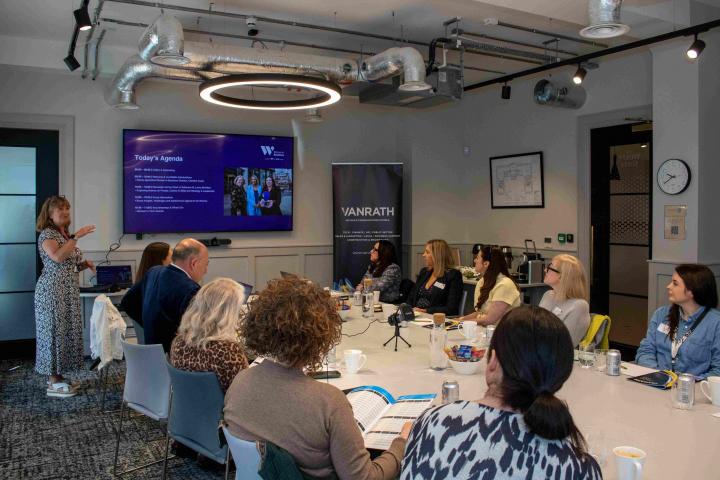
Women In Business recently organised a roundtable of senior female leaders from across Northern Ireland's technology sector to discuss some of the industry's most persistent challenges: attracting, retaining, and elevating women in tech.
The meeting took place in the iconic Custom House Belfast hosted by Barbara McKiernan, Managing Director VANRATH, the headline sponsor at the upcoming Women in Tech Awards and Caroline Coyle, Women in Business Director.
Sync NI was there to cover the event, a candid, experience-driven conversation that moved well beyond statistics and into the practical realities of culture, mentorship, leadership, and a rapidly evolving AI landscape. Here are the key themes and recommendations that emerged from the day.
READ MORE: Leading Entrepreneurs Gather for Landmark 10th Women in Business All-Island Conference
The Retention Problem Is a Culture Problem
Getting women through the door is only half the battle. Several leaders around the table were frank about the fact that their organisations struggle not with recruitment, but with keeping women long enough for them to grow into senior roles.
One recurring theme was the tendency for women to gravitate organically toward teams led by female managers, often teams that consistently ranked among the highest performers within the organisation. The reason, participants agreed, was not simply gender solidarity, but empathy. Women in those teams reported feeling understood by leaders who could relate to the realities of caring responsibilities, maternity leave, and the constant juggling act that disproportionately falls to women regardless of how supportive their organisations claim to be.
The recommendation from the group was clear: organisations cannot rely on good intentions. Senior female leaders must be intentional about creating structured internal networks where junior women are visible to and supported by those further along in their careers. One participant described a tiered mentoring model being piloted in her organisation, where mid-level staff support those just entering the business, while senior leaders mentor those ready to step into leadership roles. The goal is to ensure that women see a credible path upward before they decide there isn't one and look elsewhere.
The Mirror Problem: Women Not Supporting Women
One of the more honest moments in the discussion came when a senior leader acknowledged that earlier in her career, she had been so focused on earning her place at the table, on being "one of the lads" that she had not done enough to bring other women along with her. Several heads around the table nodded in recognition.
This is what might be called the mirror problem: women who have succeeded in male-dominated environments can sometimes, unconsciously, replicate the very behaviours that made it difficult for them to progress. The antidote, the group agreed, is not to exclude men from the conversation, but to build a culture of active inclusion where elevating women is not seen as coming at the expense of their male colleagues, but as making the whole team stronger.
The most effective teams, multiple participants observed, often tend to be those led by male leaders who are genuine advocates for gender balance often, though not exclusively, men who have daughters or sisters and have developed a natural empathy for the challenges women face in professional environments. Leaders like this don't just tolerate different communication styles; they design their team cultures around them.
Finding Your Voice and Helping Others Find Theirs
One theme that surfaced repeatedly was the difficulty many women experience in having their voices heard in technical environments, particularly early in their careers. One participant recalled being told by a senior male leader and mentor that she was routinely letting others speak over her in meetings, and that what she had to contribute was more valuable than what was being heard. That intervention, she said, changed the trajectory of her career.
The message to organisations was unambiguous: don't wait for women to raise their hands. Deliberately create environments where different communication styles are respected, where speaking over colleagues is not rewarded, and where leaders model inclusive behaviour visibly and consistently. As one leader put it, the presence of a "Women in Tech" banner on a company website means far less than whether women in that company actually feel their contributions are valued day to day.
The Education Gap Starts Earlier Than You Think
The conversation turned to a challenge that begins well before the workplace: the educational pipeline. Participants flagged the A-level system in Northern Ireland as a structural barrier, noting that students are required to narrow their subject choices at a stage when many young women are yet to discover an interest in technology. Broader curricula, as seen in other markets, tend to keep boys and girls studying STEM subjects together for longer which in turn produces a more balanced pool of candidates entering higher education and the workforce.
Several leaders also pointed to the role of parents as under-acknowledged gatekeepers. Families who are not themselves in the technology industry often default to steering academically capable children toward medicine or law, simply because they are not aware of the breadth and earning potential of careers in tech. Changing parental perceptions could be just as impactful as any school outreach programme.
There was broad support for deeper engagement between technology companies and secondary schools not just career talks, but hands-on curriculum contribution. The group noted that proposed legislation requiring software companies in Northern Ireland to nominate representatives to teach parts of the tech curriculum in schools is a step in the right direction.
AI as Both Challenge and Opportunity for Gender Balance
The latter part of the discussion moved into the evolving role of artificial intelligence — and its implications, both for women in tech and for the industry as a whole.
One organisation described a sophisticated hub-and-spoke governance model for AI deployment, and noted with interest that the hub, responsible for oversight, guardrails, and ethical decision-making, was disproportionately staffed by women. Several participants suggested this was not a coincidence. Data analytics and AI governance roles are relatively new disciplines, unburdened by the decades of male-dominated hiring patterns that still shape software engineering teams. For organisations looking to diversify, these emerging areas represent a genuine opportunity.
The group was candid about the risks, however. There was concern about the halting of graduate recruitment programmes as companies lean into AI-driven productivity gains. The worry is that today's cost savings create tomorrow's skills vacuum. This could lead to a generation of engineers who never developed foundational capabilities because they skipped the early career years where those skills are formed.
There was also discussion of what one participant called "AI brain fry" describing the cognitive overload that comes when AI tools dramatically accelerate output but human capacity to review, validate, and direct that output hasn't kept pace. The consensus was that AI is not replacing human judgement; it is, at its best, amplifying it. But that distinction requires strong leadership and a clear-eyed governance framework to sustain.
Practical Recommendations.
Across the discussion, a number of solid and practical recommendations emerged for organisations serious about improving gender balance in their teams:
Firstly, build structured mentoring programmes with visible role models at every level. Don't rely on informal networks. Create deliberate touchpoints between junior women and experienced senior leaders within the organisation.
Secondly, nominate your people for industry awards. The Women in Tech Awards were highlighted as a meaningful, tangible way to boost the confidence and visibility of women who are doing exceptional work but are not being recognised outside their immediate teams.
READ MORE: Northern Ireland’s Leading Tech Talent Revealed in 2026 Women in Tech Awards Shortlist
Thirdly, invite men into the conversation. The group agreed to explore a dedicated male advocates session as a future forum event recognising that cultural change in organisations will not happen without engaging the men who currently hold the majority of senior positions.
Next, engage with industry bodies and working groups. Organisations were encouraged to consider membership with Software Northern Ireland and to actively nominate women — particularly those earlier in their careers to participate in working groups covering education, talent, and future technology.
Finally, show up, and bring someone with you. Whether it is a roundtable, a conference, or a speaking engagement, bringing a junior colleague along, especially one who would never attend on their own is an act of mentorship in itself.
The conversation around the table reflected both the genuine progress that has been made and the considerable distance still to travel. What was striking was the absence of resignation. These are leaders who have navigated significant barriers, and they are not waiting for structural change to happen from the top down. They are building the culture they wish they had been part of to benefit the next generation of Women in Tech.

Read the Summer 2026 edition free online →
Stay connected with NI's tech community: