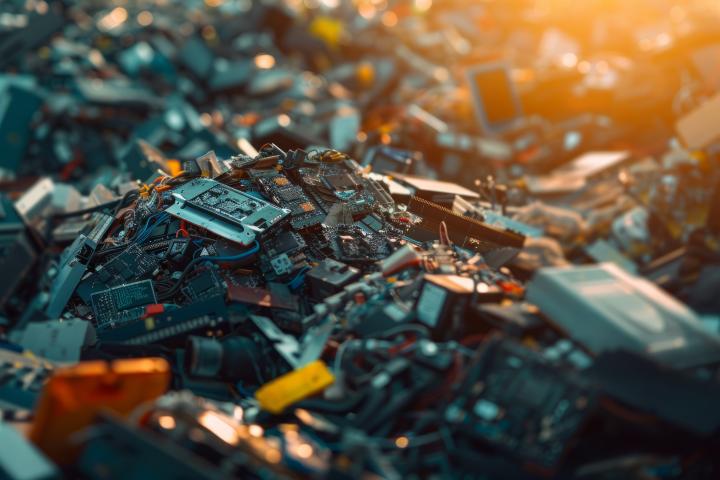
Researchers from Queen’s University Belfast are leading a £2.9m international project, creating new technologies to help tackle a major electronic waste problem in Malaysia.
Old phones, laptops and other devices are often thrown away when no longer needed. In Malaysia, this is causing a serious problem.
At Queen’s, scientists from the School of Chemistry and Chemical Engineering have been awarded £2.3m of the funding and are leading an international team of experts (iRECYCLE-Malaysia) to tackle it.
The expert team are developing environmentally gentle chemical processes to extract precious metals, such as gold, copper and rare earths from the e-waste.
They’re also developing novel leaching chemistries and working on separating plastics, while focusing on the scale-up needed to take these processes from the laboratory to industry.
On the plastics side, the chemistry is complemented by recycling research in the university’s School of Mechanical and Aerospace Engineering. The researchers are working together to develop safer ways to separate and reuse the polymer components of printed circuit boards and reduce pollution.
Professor Peter Nockemann is leading the team at Queen’s University Belfast. He comments: “I am delighted that, in the project’s first year, our international team has made strong progress in developing new electroleaching and mild leaching methods to recover valuable metals from electronic waste. In Malaysia, the volume of e-waste is vast, and growing.
“It is a huge global problem as e-waste can contain lead, mercury and cadmium - these pollute soil and water resources if not recycled correctly. However, there is also a massive opportunity: e-waste contains many precious and critical metals.
“We have been working in collaboration with experts globally, using green chemistry, to come up with innovative technological solutions to process this e-waste and recover metals such as gold, copper and rare earths. We are also developing safe ways to separate polymer components of circuit boards - this will help to reduce pollution.”
Malaysia generates an estimated 365,000 tonnes of e-waste domestically each year, with the country projected to produce as much as 1.4 million tonnes annually by 2030.
On top of this, Malaysia has historically faced large volumes of illegally imported e-waste from wealthier nations. In a recent investigation, the global waste trade watchdog Basel Action Network (BAN) described this as a new, almost “invisible tsunami” of e-waste flowing into Southeast Asia.
In February 2026, the Malaysian government announced a full ban on the importation of electronic waste, vowing that the country would not be a “dumping ground” for the world’s waste.
The project extends well beyond the laboratory. The team brings together chemists, mechanical engineers, environmental scientists and economists from across Queen’s, with matching multidisciplinary teams at the Malaysian partner universities.
The project is also engaging directly with Malaysia’s informal recycling sector, which currently handles around 75 per cent of the country’s e-waste, often under unsafe conditions. This work aims to support a transition to safer, formalised recycling that protects workers, the environment and Malaysia’s progress toward a circular economy.
The iRECYCLE-Malaysia team meets regularly through symposiums, and the partners are working together to develop clean energy technologies and boost Malaysia’s circular economy.
Following the inaugural UK-Malaysia E-Waste Futures Symposium held in Kuala Lumpur in December 2025, the second symposium will be hosted in Belfast in June 2026, bringing together researchers, policymakers and industry partners from both countries.
READ MORE: Queen’s wins UK University of the Year as Students' Union retains top spot
Professor Nockemann adds: “Working together, we are confident that we can really make a difference, creating a cleaner, more circular e-waste system in Southeast Asia. Our symposium in Belfast is an important opportunity to showcase progress and build new partnerships.”
The researchers at Queen’s are working with partners at Universiti Teknologi PETRONAS (UTP) and University of Malaya (UM).
iRECYCLE-Malaysia is funded by the UKRI Ayrton Fund Challenge Programme, which promotes equitable partnerships between UK and in-country researchers to ensure projects are locally relevant and impactful. To find out more about iRECYCLE-Malaysia, click here.
Read the Spring 2026 edition free online →
Stay connected with NI's tech community: