In the lead-up to the ongoing Middle East crisis, growth signals in the Northern Ireland economy remained weak and uneven in Q1 2026, with little evidence of confidence or momentum building. That is according to the latest Quarterly Business Insights report from NI Chamber and Queen’s University Belfast.
While most key indicators remain marginally positive, meaning slightly more firms report improvement than deterioration, the margins remain narrow and have not strengthened. The overall picture is one of an economy that is holding up but failing to build sufficient momentum to support stronger growth.
Profitability
Around 72% of firms report some level of profitability, indicating that most businesses remain in positive territory. However, this is largely driven by moderate rather than strong performance. Only 10% of firms report high profitability, while the largest share (44%) report moderate profitability, pointing to an environment where firms are trading, but not strongly.
Cost pressures remain firmly embedded. Price balances are still clearly positive across manufacturing and services, indicating continued cost pass‑through, particularly for labour costs. As a result, margins remain under pressure despite broadly positive activity indicators.
Confidence
Business confidence remains positive but eased slightly in Q1 2026. Turnover expectations stand at +28% in both manufacturing and services businesses, pointing to steady rather than strengthening optimism. Profit expectations are also positive, though more subdued, at +9% in manufacturing and +14% in services, highlighting continued pressure on margins.
Investment intentions are positive but cautious. Training investment continues to lead, with stronger balances in both sectors. Capital investment remains more modest, indicating a continued reluctance to commit to large-scale spending.
Recruitment
Recruitment activity strengthened in Q1 26, but this is not translating into stronger employment growth. Hiring remains active but is increasingly focused on replacement rather than expansion, reflecting ongoing skills shortages and capacity constraints. Recruitment difficulties are extremely elevated, with 100% of manufacturers and 77% of services firms reporting difficulties in filling vacancies.
Just over half of firms (54%) currently employ graduates, while 41% have never done so. Among firms that do employ graduates, 28% report reducing graduate recruitment over the past two to three years, compared to 17% increasing it, citing skills mismatch and cost pressures as key reasons.
Trade
The impact of the Windsor Framework remains uneven. Around 46% of firms report some impact, with the main challenges relating to clarity on NI/EU rules (61%), use of the Trader Support Service (45%) and regulatory divergence (40%). Those impacted continue to face complexity and an administrative burden.
Views on the ‘goods at risk’ test reflect this picture. Amongst those with a view there is a clear balance in favour of a review of the test, with 35% supporting a review compared to 8% opposed. This is driven by concerns around cost, administrative burden and lack of clarity.
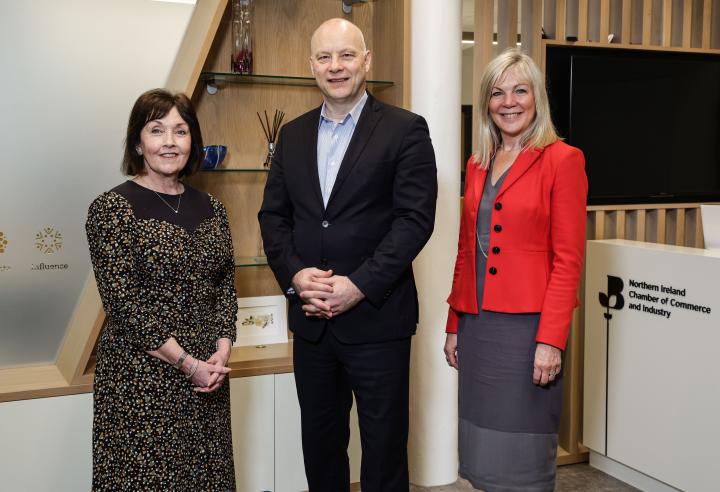
Commenting on the findings, Suzanne Wylie, Chief Executive of NI Chamber said that while businesses continue to trade and many are investing in people, they are doing so in an increasingly challenging environment:
“This report confirms that even before the recent escalation in the Middle East, businesses in Northern Ireland were operating in a fragile, low-growth environment. We stand ready to work in partnership with the UK Government to best understand and support businesses through this challenging period.
“At the same time, the Northern Ireland Executive must not lose sight of the long-term structural issues firmly within its control, starting with putting Northern Ireland on a credible path to financial sustainability through a comprehensive review of public spending.
“At the same time, we urgently need progress on the long-standing barriers to growth that continue to hold back investment, particularly skills, planning, and wastewater capacity constraints that are preventing development right across Northern Ireland.”
Stressing that Northern Ireland ‘needs greater ambition for its economic future’ she said:
“Businesses want to see an agreed, long-term economic plan that provides clarity, certainty and direction, and which we can all get behind. With the right policy framework in place, firms are ready to invest, grow and play their full part in delivering sustainable economic growth.”
She also stressed that reducing unnecessary complexity is essential if the Windsor Framework is to provide the stability and certainty that businesses need:
“On trade, it is vital that both the UK and EU continue to uphold their commitments under the legal text of the Windsor Framework to keep its operation under constant review. That must include reviewing the ‘goods at risk’ test to ensure it is as simple, proportionate and up‑to‑date as possible, and reflects the capabilities of modern supply‑chain technology.”
Professor Richard Ramsey, Professor of Practice at Queen’s Business School, added:
“The Q1 results point to an economy that is proving resilient, but where weak demand, persistent cost pressures and severe labour market constraints continue to limit momentum. Northern Ireland’s relative UK performance increasingly reflects resilience rather than strong growth.”